


The creator economy has matured quickly. Platforms like Patreon, Substack, and Kajabi built entire businesses around creator memberships. But they also introduced a tradeoff: the audience relationship lives on someone else’s platform.
Many creators now want something simpler: a membership program they control, connected directly to their store and customer list.
If you already run a Shopify store, you can often do exactly that.
Why memberships matter for creators
Creator income is famously unpredictable. Advertising revenue fluctuates, platform algorithms change, and sponsorships come and go.
Memberships solve a different problem: they create direct, durable relationships between creators and their audiences.
That relationship is becoming increasingly important. SignalFire estimates that more than 50 million people now identify as creators worldwide, but only a small percentage earn consistent income from their work.
Membership programs help close that gap by converting a small portion of an audience into recurring supporters.
What creators actually sell as membership value
Creators don’t just need an audience. They need a direct relationship with that audience.
Memberships for creators rarely revolve around discounts or traditional perks.
Instead, they usually unlock access to things the audience already values:
- exclusive posts or videos
- downloadable resources or templates
- private communities
- early product releases
- live Q&A sessions or events
Shopify already handles payments and customers. Membership software adds access control and recurring billing to the mix.
Three membership models creators can run on Shopify
1. Paid community membership
Communities are one of the most popular creator membership formats.
A creator might run a paid Slack, Discord, or Circle community where members can ask questions, share work, or participate in discussions.
This is where Shopify tags become useful.
When someone purchases a membership product, Zendra creates the membership and automatically applies the Member tag to the Shopify customer.
From there, automation tools can connect Shopify to community platforms.
For example:
- Membership purchase → Zendra creates membership
- Customer receives the Member tag
- Automation tool (Zapier, Make, etc.) detects the tag
- User is invited to a Slack or Discord community
Automation platforms like Zapier already support Shopify triggers and Slack actions, making it possible to connect store events to community tools (Shopify–Slack automation example).
The result is simple: buy membership → automatically join the community.
To close the loop, consider having an off-boarding automation, too: when that tag is removed from a customer, have Zapier remove them from the community. (Zendra will automatically remove Member tags if a member cancels or the membership expires.)
2. Content library access
Another common model is a gated content library.
This works especially well for creators who produce tutorials, courses, or educational material.
Examples include:
- video tutorials
- premium articles
- design templates
- coding resources
- research archives
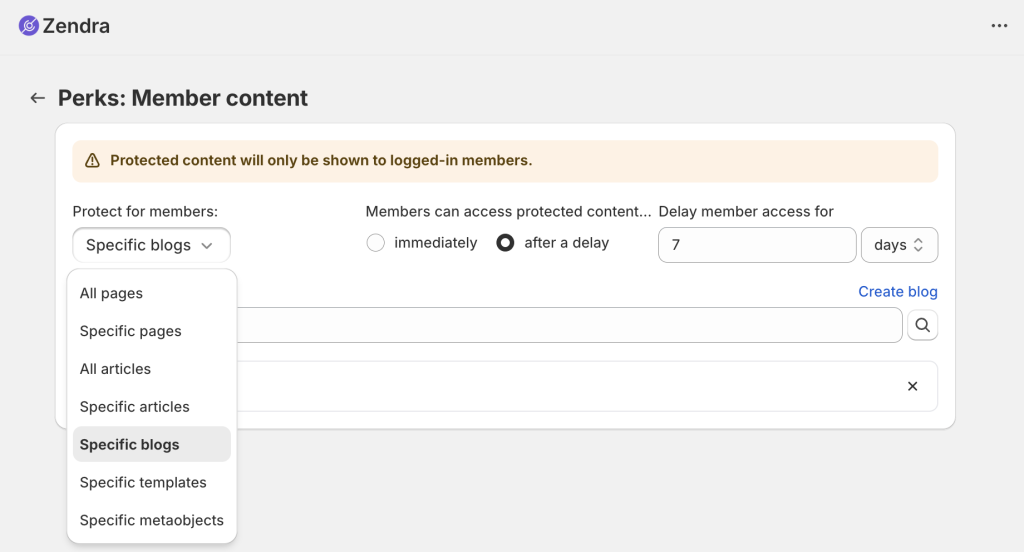
Members receive access to protected pages or downloadable files once their membership is active.
3. Patron-style support membership
Some creators use memberships simply as a way for fans to support their work.
This model resembles Patreon. Members may receive occasional perks — like early access to releases or special recognition — but the primary motivation is supporting the creator directly.
Zendra lets you create a membership through a one-time purchase, or via recurring billing, letting patrons subscribe for support.

Owning that relationship through Shopify means the creator retains full control of customer data and revenue.
Why Shopify can be a better home for creator memberships
Creator membership platforms are useful, but they also create dependencies. Running memberships through Shopify has a few structural advantages:
- customer ownership
- membership and product sales in one store
- flexible integrations with email, communities, and automation tools
For creators already selling digital or physical products, this consolidation simplifies operations significantly. Just be aware of some common mistakes:
- Overpromising content. Publishing schedules that are too aggressive often become unsustainable.
- Locking everything behind the membership. Public content still plays an important role in attracting new audience members.
- Creating too many tiers. Simpler membership structures tend to convert better.
Own the relationship via creator memberships
The creator economy has made it easier than ever to reach an audience, but audiences on social platforms are rented.
Membership programs give creators something more durable: a direct relationship with the people who care most about their work.
For many creators, Shopify is already where that relationship begins.





Leave a Reply