

Flat discounts are simple; they also tend to be lazy.
If you want repeat purchases, stronger retention, and healthier margins, milestone rewards are often a better tool. They don’t just reduce price: they create progress — and progress changes behavior.
Let’s talk about the psychology behind milestone rewards, why they often outperform always-on discounts, and exactly how to automate them with Shopify Flow using Order paid triggers and Zendra’s Flow actions (Create membership and Add store credit).
Why milestones work better than percentage-off
Milestone rewards lean on a well-studied behavioral pattern: people increase effort as they feel closer to a goal.
Kivetz, Urminsky, and Zheng demonstrated this in real loyalty programs: participants purchased more frequently as they approached a reward, and “illusionary progress” (making people feel closer to the goal) increased acceleration and retention. In one example study, starting customers with 2 holes punched on a 10-purchase loyalty card was more effective than giving someone an empty 8-purchase card, even though both cards require 8 purchases to earn a reward.
Nunes and Drèze found a related effect: giving customers a head start toward a reward increased persistence and completion. In their “endowed progress” experiments, people worked harder when they felt the journey had already begun (Journal of Consumer Research PDF).
Both findings point to the same practical takeaway: milestone rewards don’t just reward purchases. They create a sense of movement — and movement is motivating.
Progress motivates more than percentage off.
Why flat discounts underperform over time
Always-on discounts are easy for customers to understand, but they often fail to build momentum. They don’t create a “next step,” and they don’t give customers a reason to come back sooner; they just reduce price and hope behavior changes.
There’s also an anchoring problem: when customers repeatedly see discounted pricing, their sense of “normal” can drift toward the discount. The anchoring effect is well documented: initial reference points influence later judgments, including price perceptions (St. Louis Fed).
Milestones avoid this price anchoring trap by framing value as achievement, not just savings. The reward feels earned. The customer feels recognized. That’s a different relationship.
Three types of milestones you can automate
Milestones can be based on spend, order count, or tenure. Each one reinforces a slightly different behavior.
1) Spend-based milestones (prestige and commitment)
Spend milestones are great when you want “earned status” to feel meaningful. Example: “Spend $250 total → get $25 store credit,” or “Spend $500 → unlock Insider membership.”
This model tends to work well for higher-margin brands, premium positioning, or any store where you want loyalty to feel like a step up, not a coupon.

2) Order-count milestones (habit and frequency)
Order-count milestones are great for driving frequency. Example: “After your 3rd paid order → $10 credit,” and “After your 5th → membership unlocked.”
This is where the goal-gradient research shines: customers accelerate as they near the next step (Kivetz, Urminsky, and Zheng).
3) Tenure-based milestones (retention and belonging)
Tenure milestones reward staying power. Example: “90 days after joining → member credit.” This is especially effective when you want membership to feel like long-term belonging rather than transactional perks.
Important technical constraint: Shopify Flow’s Wait action has a maximum delay of 90 days per flow (Shopify Flow: Wait action). That means you can target quarterly tenure, not annual.
How to build these in Shopify Flow
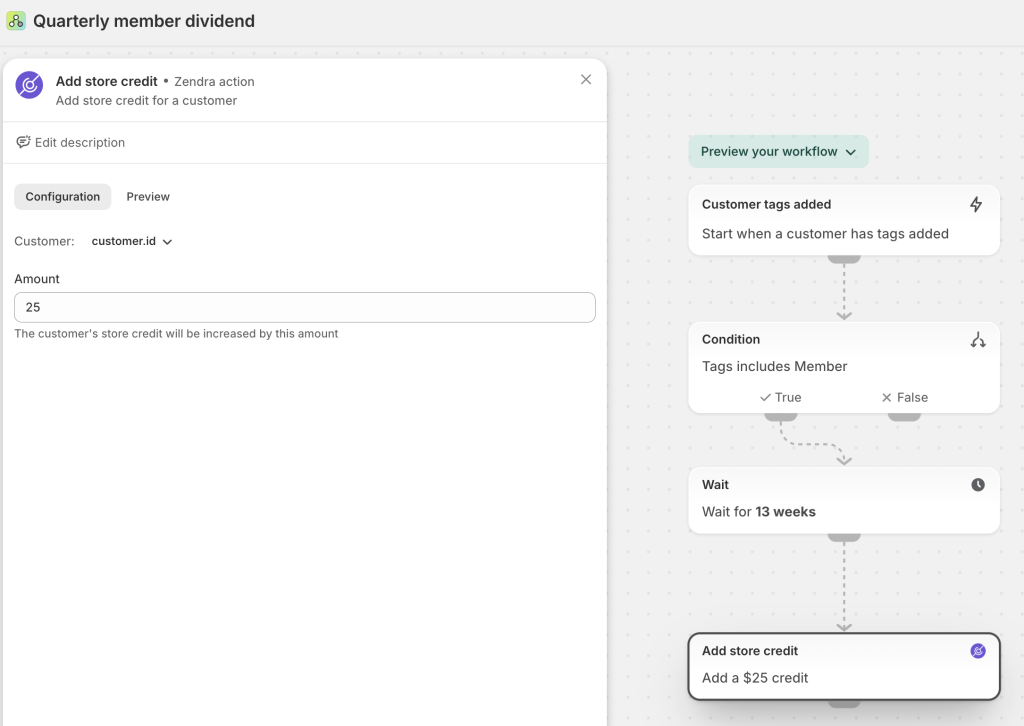
For purchases, use Shopify Flow’s Order paid trigger. It starts the workflow when an order’s payment status changes to paid (Shopify Flow: Order paid trigger).
Using paid rather than created is a practical choice: it avoids counting unpaid, pending, or problematic orders toward milestones.
Workflow 1: reward the 3rd paid order with store credit
Trigger: Order paid
Condition: Customer order count ≥ 3
Action: Add store credit (Zendra)

Workflow 2: unlock membership on the Nth paid order
Milestones work best when they’re predictable for customers and automated for you.
Trigger: Order paid
Condition: Customer order count ≥ 5 (Or whatever threshold you choose)
Action: Create membership (Zendra)

Workflow 3: combine status and reward at the same milestone
If you want the milestone to feel like a true “graduation moment,” combine both actions.
Trigger: Order paid
Condition: Customer lifetime spend ≥ $500
Actions: Create membership (Zendra) + Add store credit (Zendra)
This structure mirrors what people find motivating: a visible status upgrade plus a tangible reward.
Restricting store credit to members
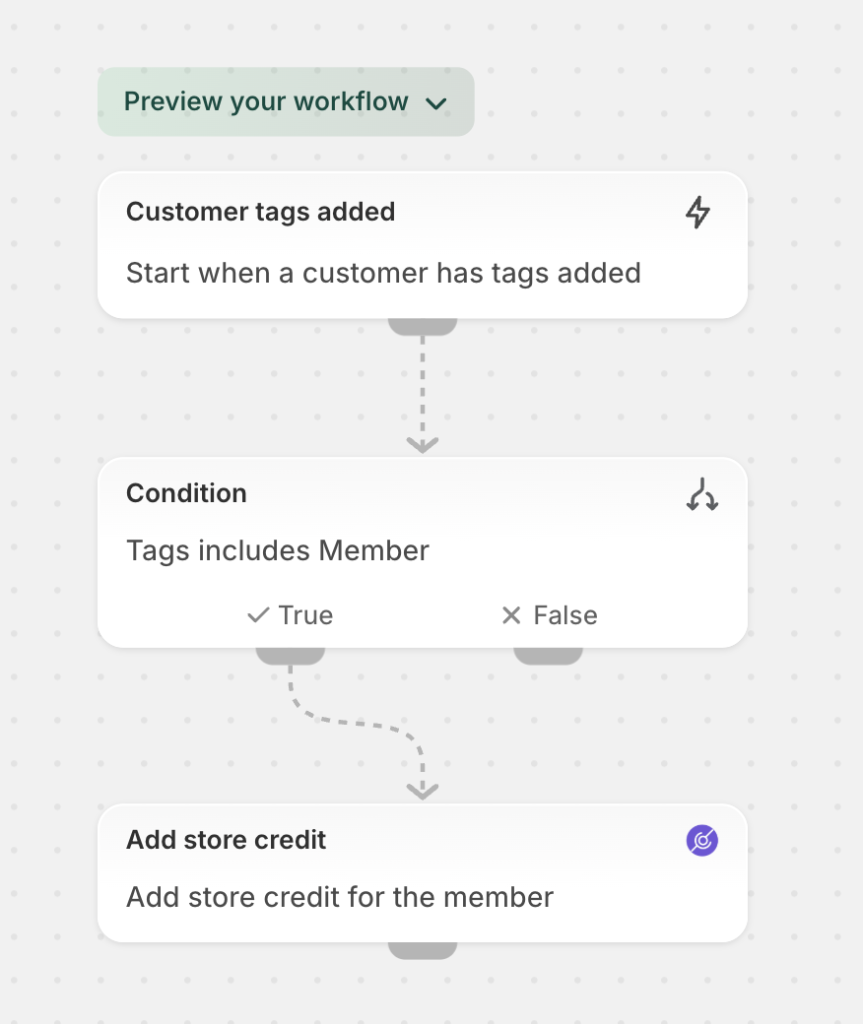
Just a quick implementation note: right now, Zendra’s Add store credit action can be used for any customer — it isn’t restricted to members by default.
If you want store credit to function as a member-only benefit, add a condition in Flow that checks whether the customer has the Member tag before running the credit action. This is a good pattern when you’re using store credit as a “dividend” for active members rather than a general promotion. (And can also let you run flows when a member joins!)
Making milestones visible to customers
Milestones only change behavior when customers know they exist.
You don’t need a complicated dashboard. A simple message in post-purchase email, account pages, or a small banner in the member portal is often enough! The objective is to make progress feel tangible.
This is also where “endowed progress” can be useful. A small head start—like counting a customer’s first purchase toward the next milestone, or telling them they’re already “1 of 5 purchases in” can increase completion rates (Nunes & Drèze, 2006).
Just be sure to avoid some common mistakes in creating your milestones:
- Setting thresholds no one reaches. If the milestone is too far away, it won’t motivate anyone. You’ll have created a program customers don’t feel, and they’ll ignore it.
- Not acknowledging the moment. If a milestone triggers and nothing changes visibly, the reward loses emotional impact. Recognition is part of the value!
- Replacing strategy with math. Milestones aren’t only about “best” thresholds — they’re about which behaviors you want to reinforce. Set your milestones based on whether you value purchase frequency, commitment, or longevity.
The simple reframe for milestone rewards
Discounts ask: “How cheap does this need to be?”
Milestones ask: “What would make a loyal customer feel seen, and what would motivate the next step?”
When you build loyalty around progress, you get a system that can compound — without anchoring your brand to permanent price cuts.




Leave a Reply