


When merchants start designing a membership program, discounts are often the first idea on the table. They’re familiar, easy to explain, and feel like an obvious way to reward loyal customers.
The problem is that flat discounts tend to do the opposite of what most membership programs are meant to do. Instead of building long-term affinity, they quietly reshape customer behavior in ways that are hard to reverse.
We wouldn’t argue against discounts in general — they can be useful tools, and we support member discounts! But as a core membership perk, they can create more problems than they solve.
Why discounts feel like the obvious choice
Discounts work well in short-term promotional contexts. Customers understand them immediately, and the value is clear without explanation. When you’re trying to get early traction, that clarity is tempting.
Memberships, though, are not promotions: they’re ongoing systems designed to influence behavior over time. The same mechanics that make discounts effective in a flash sale can undermine a membership when they’re always on.
The moment price becomes the primary value of membership, everything else gets reframed around savings.
What discounts actually do inside a membership
In a membership context, a flat discount changes the customer’s mental model. Membership stops feeling like access or belonging and starts feeling like a standing coupon.
That shift has a few predictable effects:
- First, customers can anchor on the discounted price, not the original value of the product — research shows that anchoring is even subconscious, based on the first number they focus on.
This works in our favor to drive an initial purchase! But it can hurt our goal to develop long-term loyalty. Over time, the non-member price begins to feel inflated, even if it hasn’t changed; other products can also feel more expensive by comparison, and the perception of your item quality can decrease. - Second, purchases become more transactional. Members learn to ask, consciously or not, “Is this worth it, is this the best price?” rather than “Do I want this from this brand?” A member with high brand affinity values having the item from your brand rather than solely valuing a good deal.
- Finally, discounts collapse differentiation. If your main benefit is price, it’s easy to compare you to every other discounted offer a customer sees.
The economic downside (without the spreadsheet gymnastics)
Always-on discounts compress margin immediately, and they do it on every order, not just incremental ones. You’re giving up revenue on purchases that would likely have happened anyway!
That matters because memberships work best when value compounds — small inefficiencies get amplified over time.
Discounts can also scale poorly, especially percentage-based offers. As order volume increases, the cost of the perk does. There’s no natural ceiling unless you add one later — which feels like a downgrade to members.
Perhaps the most under-appreciated cost is optionality. Once a discount becomes the core perk, it’s hard to remove or reduce it without backlash. You can lock your membership into a narrow value proposition, hampering its growth.
The behavioral side effects merchants underestimate
The longer a discount-based membership runs, the more it shapes expectations.
Customers begin to wait. They delay purchases in anticipation of better value. Full-price buying starts to feel irrational rather than supportive.
Brand perception shifts as well. When price is the headline benefit, your quality, craftsmanship, and differentiation fade into the background. The brand becomes a vehicle for savings rather than a destination.
This isn’t always obvious right away. It shows up gradually, in lower engagement with non-discounted products and weaker response to launches that don’t come with a deal attached.
When discounts can make sense
None of this means discounts should never appear in a membership program! In fact, we think discounts are exceptionally powerful perks to offer to your members.
Permanent discounts redefine the relationship, but temporary incentives encourage action.
They work best when they’re narrow, intentional, and secondary to the main value. For example, a limited discount on specific categories, or occasional member-only pricing tied to inventory goals. This is where Zendra shines:
- Specific products, collections, and tags can be targeted for discounts to keep them focused for “special” items.
- You can activate or deactivate your member discounts manually to run member flash sales.
- You can schedule member discounts as a promotion or members-only sale!
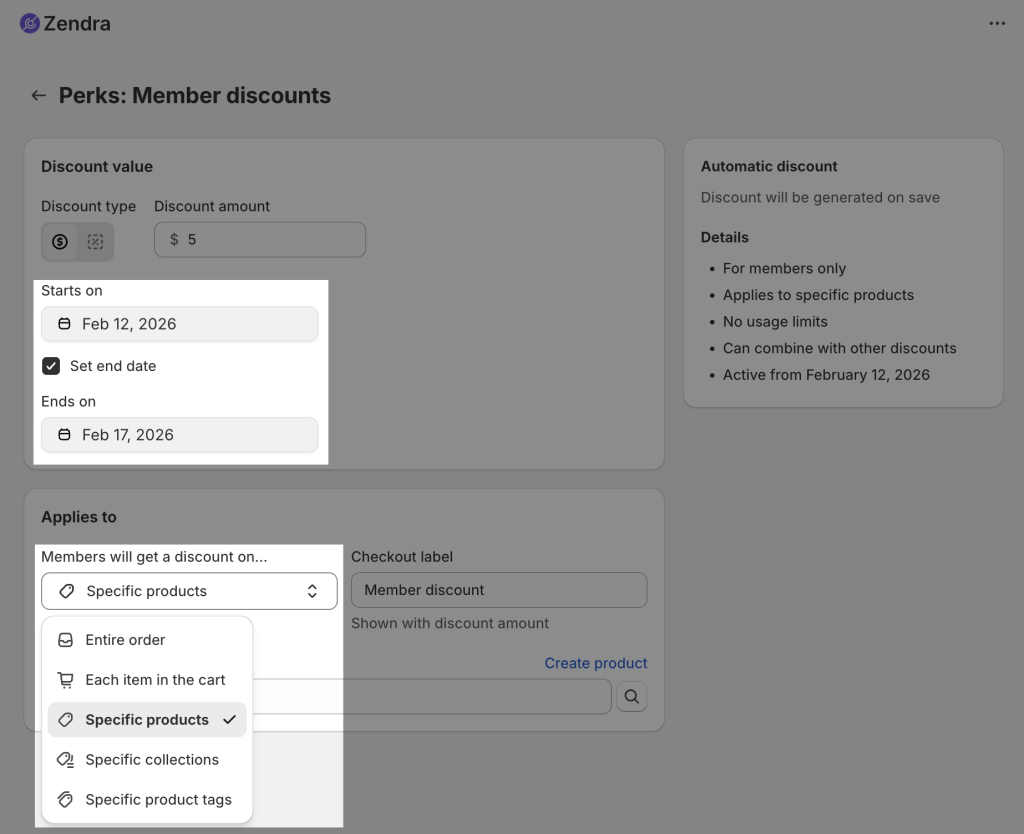
The key distinction is permanence. Permanent discounts redefine the relationship, but temporary incentives encourage action.
Better membership perks for most brands
Most successful membership programs focus on reducing friction or increasing access, rather than lowering price.
Shipping and returns are common areas to reduce friction — removing friction at checkout makes buying easier without directly devaluing the product itself.
Access-based perks are another strong alternative: early access to launches, member-only products, or gated collections create a sense of belonging that doesn’t rely on price comparison.
Review our common models for membership programs to dig deeper into the right perks for your store.
For brands with repeat purchase behavior, subscriptions or subscribe-and-save-style benefits can deliver ongoing value while reinforcing habit. These perks align the business’s incentives with the customer’s behavior instead of working against them.
What all of these have in common is that they support repeat engagement without training customers to anchor on discounts.
A calmer way to think about membership perks
Memberships are most effective when they feel like a quiet advantage, not a constant negotiation over price.
Rather than asking, “What can we give members?” it’s often more useful to ask, “What behavior are we trying to encourage?”
- If the goal is more frequent purchases, reduce friction.
- If the goal is deeper engagement, create access.
- If the goal is predictability, support recurring behavior.
Once the behavior is clear, the right perk usually follows naturally. Memberships are most effective when they feel like a quiet advantage, not a constant negotiation over price.
Start simple, then adjust. Many brands feel pressure to launch with a fully formed perk stack. That pressure often leads straight to discounts.
A simpler approach is to start with one or two non-price perks, watch how customers respond, and evolve from there. You can more easily add value than take it away!
Discounts aren’t inherently bad — they can be super effective tools, but static, always-on discounts are blunt instruments. To create a system to build long-term affinity, be more precise.
If you’re designing a Shopify membership today, it’s worth pausing before reaching for the percentage sign to make sure your membership program compounds its value over time.






Leave a Reply