

Every holiday season, Shopify merchants deploy the same fallback when a customer wants to buy something for someone else: a gift card. It’s the path of least resistance: easy to set up, easy to redeem, easy to forget. But that last part is the problem — a gift card is a one-time transaction wearing a bow. It moves money, and then it’s done.
A gift membership does something a gift card structurally can’t; it gives the recipient a reason to keep coming back.
If you run a membership program — a creator community, a VIP club, or a subscription with real perks — letting customers gift access is one of the most valuable things you can offer. This guide walks through how to sell gift memberships on Shopify with Zendra: how buyers give them, how recipients claim them, how to set it up, and why the model earns more repeat business than a gift card ever will.
Gift membership vs. gift card
Even though gift memberships and gift cards drive a similar short-term outcome (a recipient receives a gift), they have different long-term outcomes: one builds a customer, the other spends a balance.
The psychology difference is important, and recipients act differently when they get a card vs a membership.
A gift card is denominated in money. The moment someone receives one, a small mental clock starts: I need to spend this. Behavioral economists call the surrounding behavior mental accounting — we treat a $50 card as a distinct pot of “free” money to be discharged, not as part of our normal budget. The card gets spent once, often on something the recipient wouldn’t have chosen with their own cash, and the relationship with your store ends at the cash register. You’ve effectively bought a single transaction at face value.
A gift membership is denominated in belonging. The recipient isn’t given a balance; they’re given a status, a set of rituals, and a reason to come back. A gift card asks, “What will you buy?”, but a membership says, “You’re one of us now.” That’s why people join memberships, and why they stay.
That reframing changes the behavior that follows. Members visit more often, because membership is a standing invitation rather than a one-time errand. They explore perks, because the perks are the point. And when the gifted term runs out, a meaningful share of them re-up with their own money — because by then the membership isn’t an abstraction, it’s a habit.
A gift card gives someone money to spend. A gift membership gives them somewhere to belong.
There’s a margin argument here too, not just a warm one. A gift card costs you the full face value in redeemed product, at your normal margin, for one purchase. A gift membership is sold at the price of the term, activates a relationship designed to repeat, and hands you a natural conversion moment at the end. The same money buys you a customer instead of a transaction. For a membership business, that’s not a close call.
None of this means gift cards are useless! For a store without a membership program, or for a recipient who genuinely just wants store credit, a card is a fine tool. This point is narrower: if you’ve built something worth belonging to, a gift card undersells it. You’re handing someone a balance when you could be handing them a seat at the table.
Best of both worlds: Create a flow to give gift recipients store credit, leveraging the “free money to spend” psychology, and giving them a reason to come back after spending it.
Gift memberships in Zendra
In Zendra, a gift membership is a prepaid contract. Three properties define it:
- It’s prepaid. The buyer pays once, upfront, for a fixed stretch of membership. There’s no card on file for the recipient and no recurring charge — the buyer covered the whole term at checkout.
- It’s claimed. The buyer doesn’t get the membership, the recipient does. After purchase, the recipient receives an invite and activates the membership themselves from a claim page. Until they claim it, the gift is waiting, not active.
- It expires. When the prepaid term ends, the membership ends. It does not auto-renew into a paid subscription.
A gifted membership will not start charging the recipient automatically when it runs out. The end of the term is instead an invitation to renew — handled by email, on the recipient’s terms.
What if recipients never claim a gift? It simply sits unclaimed and inactive — so it’s worth nudging recipients to check their email. An unclaimed gift doesn’t silently start its clock.
The buying experience: choose a recipient
Gifting isn’t a separate product or a parallel checkout. It lives inside the same membership purchase widget — the theme app block — that your regular members already use to subscribe. When gifting is enabled, the widget shows a small chooser at the top: Myself or As a gift. A customer buying for themselves never has to think about it; a customer buying for someone else picks “As a gift” and the form adapts.
That “same product” detail matters for you as the merchant, not just the buyer. Because a gift sells through the same membership product — not a separate gift SKU or duplicate listing — you don’t maintain a parallel catalog of “gift versions.” Sales of a membership and its gifted equivalent roll up under one product in your reporting, and inventory (if you track it) draws from the same item, so your numbers stay clean automatically. You decide which terms are giftable; Zendra handles the plumbing behind the same listing.
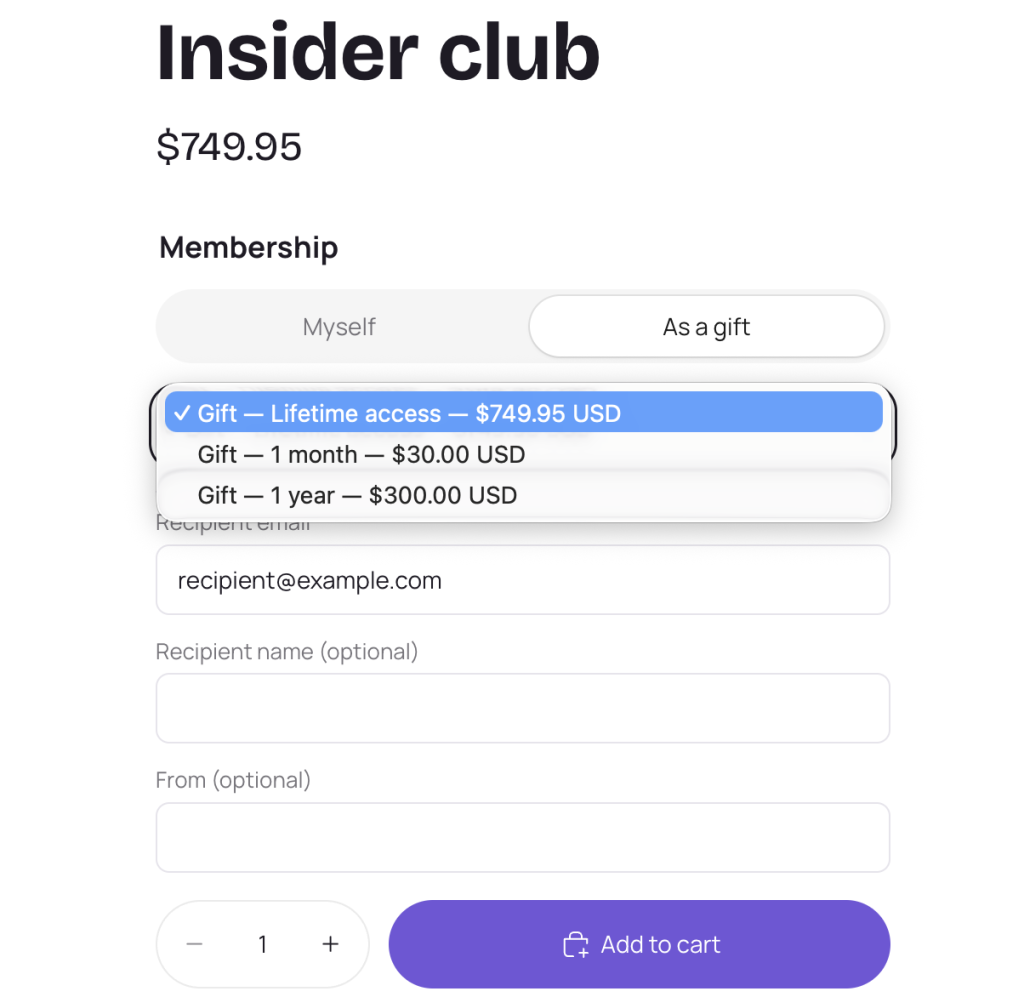
Choosing “As a gift” asks the buyer for three things:
- Recipient email (required) — where the claim invite will be sent.
- Recipient name (optional) — so the invite can address them.
- A “From” name (optional) — so the recipient knows who it’s from.
One thing the buyer is not asked for is the length of the gift. There’s no duration slider or term picker. The length of a gifted membership is simply the billing option the buyer chose.
The claim experience: invite email and landing page
The buying and claiming sides are two separate journeys — the claim side is triggered once the buyer completes purchase.
When the order completes, Zendra sends the recipient a gift claim invite email. It’s addressed to them (using the recipient name, if the buyer provided one), names who it’s from (if a “From” name was given), and links to a claim landing page.

On the claim landing page, the recipient confirms and activates the membership. From that point the membership behaves like any other active membership in your store: perks apply, gated content unlocks, community roles assign, and the recipient can manage everything from the customer account portal. The prepaid clock starts at claim, and runs for the length of the term the buyer purchased.
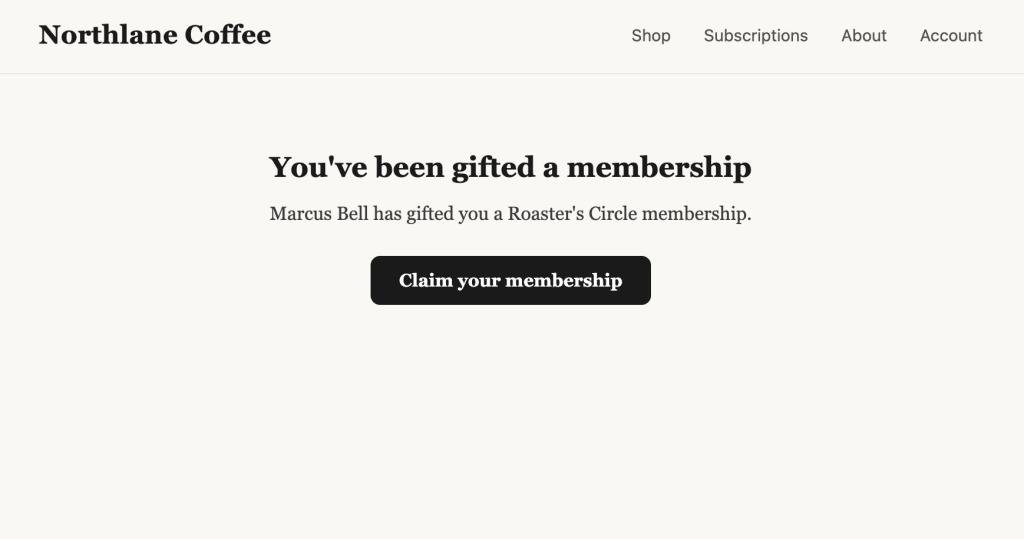
The handoff is clean. The buyer never has to relay a code, and the recipient never has to enter payment details — they click through from their email and they’re in.
How to set up gift memberships on Shopify
Setup is a toggle, not a full-blown project. Gift memberships are available on Zendra’s paid plans (Starter and up), and once you’re on one, enabling gifting takes a single switch per billing option.
Each billing option on a plan has an “Allow gift purchases” toggle (including one-time purchases). Turn it on, and that option becomes giftable; the prepaid duration of the gift is that billing option’s own interval. There’s no separate “gift length” field to set, because the interval is the length. A twelve-month billing option, gifted, is a twelve-month prepaid membership.
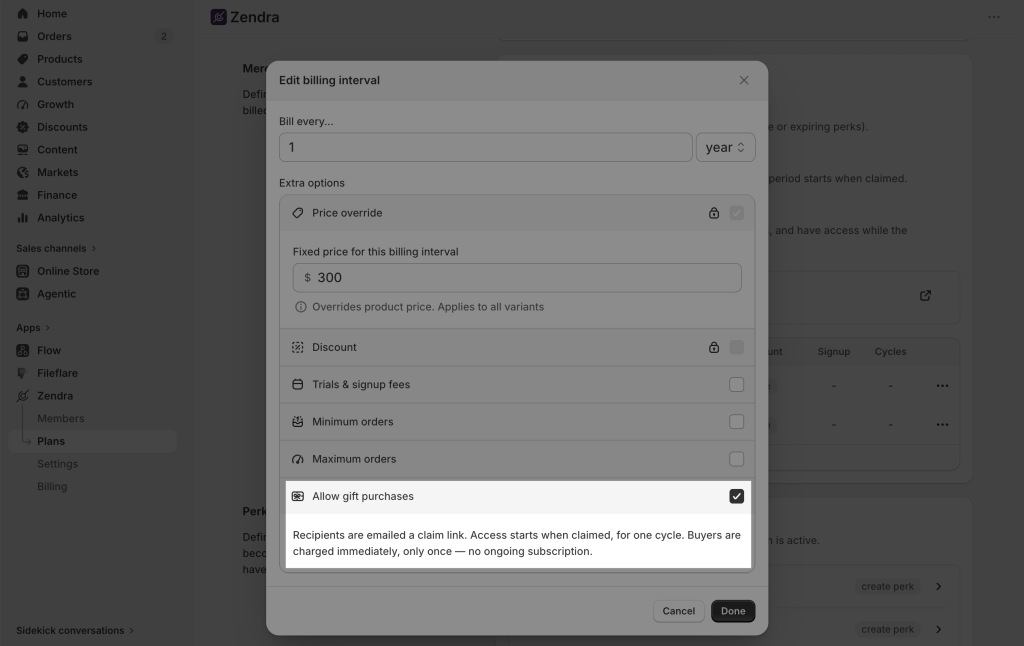
This is also how you offer multiple gift lengths: you configure multiple billing options and enable gifting on each. Want three-month and twelve-month gifts? Create a three-month billing option and a twelve-month billing option, switch on “Allow gift purchases” for both, and buyers will see both lengths in the widget’s “As a gift” flow. If you only want to gift annual memberships, enable gifting on the annual option alone.
Decide which terms make sense as gifts, enable gifting on those billing options, and you’re live! Everything downstream — the product page selector, the claim email, the expiry management — will adapt automatically.
The three gift emails
On top of Zendra’s eight standard membership lifecycle emails, gift memberships add three more. All three are customizable, like the rest of your notifications.
- Gift claim invite: sent to the recipient when the order completes, inviting them to claim and activate their gift. This is the email that starts the whole relationship, so it’s worth making it feel like a welcome rather than a receipt.
- Prepaid ending soon: sent to the recipient as the prepaid term approaches its end. This is the conversion moment, and it deserves attention. The recipient has spent the full term experiencing your perks as a member; this email is your chance to invite them to continue with their own subscription. A gifted membership that doesn’t auto-renew isn’t a missed opportunity — it’s a better one, because the recipient who chooses to renew is choosing you on purpose. Treat this email as a soft, genuine invitation, and it can become one of the most efficient acquisition touchpoints in your program.
- Prepaid expired: sent when the term has ended and the membership has lapsed. A graceful “your access has ended, here’s how to come back” note keeps the door open for anyone who let the “ending soon” email slide.
When gifting a membership fits
Giftable access isn’t equally useful for every program. It shines wherever the thing being given is belonging, and lands flat if a gift card would truly serve better. A few models lend themselves well to gift memberships, vs gift cards:
- Creator and community memberships. When your membership is access to a community — a Discord, a content library, or a group of people who share an interest — gifting it is gifting someone into a room they want to be in. A gift card to a creator’s store is forgettable; the membership to the creator’s community is the actual gift. This is the strongest fit, because the social pull of belonging is what drives the recipient to renew themselves.
- Wholesale and VIP clubs. A gifted VIP tier is a powerful introduction. Picture a member sponsoring a peer into your VIP club, or a business gifting a wholesale buyer a trial of premium terms. The recipient experiences the full insider treatment for a real stretch of time, which is far more persuasive than describing the tier in a sales email.
- Seasonal and occasion gifting. Holidays, birthdays, and milestones are when people reach for gift cards by default. A membership is the upgrade — instead of a balance that gets spent and forgotten by mid-January, the recipient gets months of being part of something, with a natural renewal conversation waiting at the end.
The common thread is that a gift membership works best when membership itself carries meaning in your store. If your “membership” is really just a discount code with a login, gifting it won’t feel like much. But if you’ve built a program people are genuinely glad to belong to — the kind worth bragging about — gifting is how you let your customers extend that feeling to the people they care about.
Turn a gift into a member
If you’re already running a membership program in Zendra, gifting is a toggle away: enable “Allow gift purchases” on the billing options you want to make giftable, and your customers can start handing access to the people they care about. If you’re not on Zendra yet, you’ll find us on the Shopify App Store — gift memberships are available on any paid plan.
The merchants who get the most from this won’t be the ones with the steepest gift discount. They’ll be the ones who built something worth joining, and then made it easy to give away.



Leave a Reply