


When designing a membership program, most brands gravitate toward one of two levers: member discounts or access.
Both can increase purchases. Both can feel valuable! But they shape customer behavior in very different ways — especially over time.
If your goal is repeat purchases rather than short-term spikes, it’s worth asking a deeper question: which lever actually builds lasting behavior?
What “repeat purchases” really mean
Repeat purchasing isn’t just about frequency — it’s about why someone comes back.
There’s a difference between a customer who returns because they saw a discount and a customer who returns because they feel connected to the brand, want early access, or check in habitually for new releases.
One behavior is reactive, the other is proactive. Over time, that difference compounds.
How discounts drive behavior
Discounts reduce friction around a single purchase. They lower perceived risk and make the immediate decision easier.
Behavioral research shows that customers anchor on the first price they see — a phenomenon known as the anchoring effect. That initial number shapes how future prices are evaluated, often subconsciously, based on research from the Federal Bank of St. Louis.
In the short term, this works in your favor. A member discount can trigger an initial purchase or increase conversion. In the long term, it can reshape expectations. Customers may begin evaluating every purchase relative to that reduced price.
Discount-driven programs tend to encourage transactional behavior. Customers ask, “Is this the best price?” rather than “Is this from a brand I prefer?”
Discounts activate purchases. They don’t always build preference.
This doesn’t make discounts inherently bad. They’re powerful tools. But as a primary membership lever, they can tilt the relationship toward price comparison rather than loyalty.
How access drives behavior
Access works differently. It doesn’t lower price; it changes who gets something and when.
Early access to launches, member-only collections, gated bundles, or private drops create a sense of anticipation. Customers check back not because something is cheaper, but because something is available to them.
Access reinforces identity. It signals belonging and insider status. And importantly, it often carries low marginal cost compared to permanent discounts.
Access builds anticipation; anticipation builds habit.
That habit — returning to see what’s new, checking in before others — is what turns repeat purchasing into a durable, long-term advantage for your brand.
Which habits your membership builds
Psychologically, member discounts function as external incentives. They provide a clear, immediate reward.
Gated access leans more on intrinsic motivation: the desire to belong, to participate early, to not miss out. Those motivations tend to be stickier over time.
This distinction shows up clearly in paid loyalty research. McKinsey reports that consumers expect to receive at least a 150 percent return on their subscription fee in new offerings. That return doesn’t always need to be pure savings; it can be access, exclusivity, or differentiated experiences.
When the perceived return comes from access rather than discounting, the brand relationship often feels stronger.
When discounts outperform access
Discounts can be the right lever in specific situations. Commodity categories with high price sensitivity, inventory clearance needs, or highly competitive markets may benefit more from price-driven membership programs.
Your member discount can apply to the entire customer cart, or you can choose select products & collections where these discounts make the most sense.
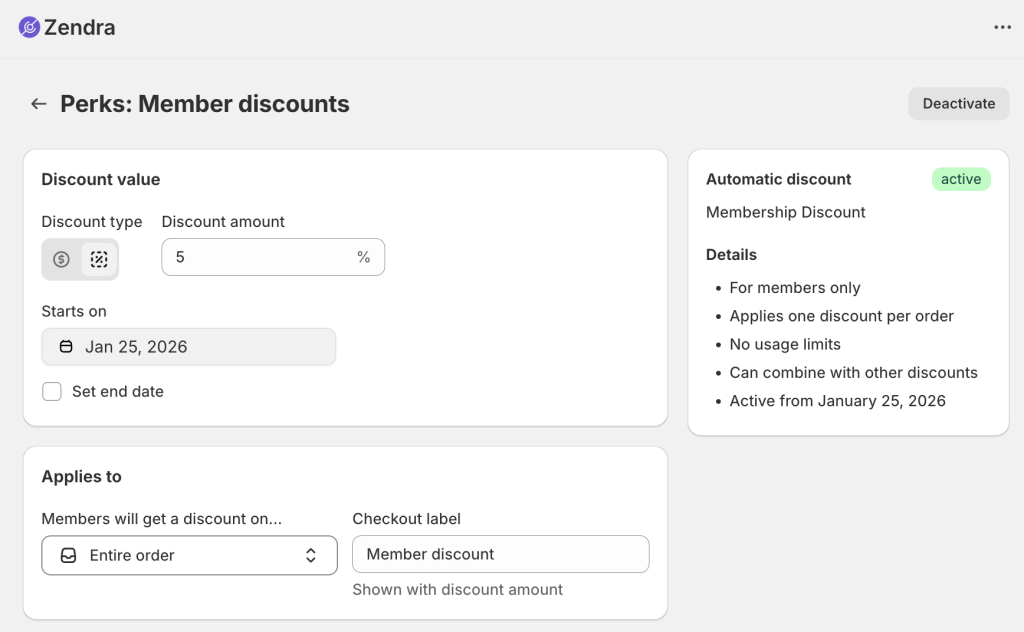
If your differentiation is minimal or switching costs are low, discounts can meaningfully influence behavior.
Also check out: Why your membership should be more than a discount
When access outperforms discounts
Access tends to outperform discounts for brands with distinctive identity, regular product launches, or communities built around niche interests.
You can control access to almost anything on your store: pages, blogs, articles, products, collections, and shipping rates.
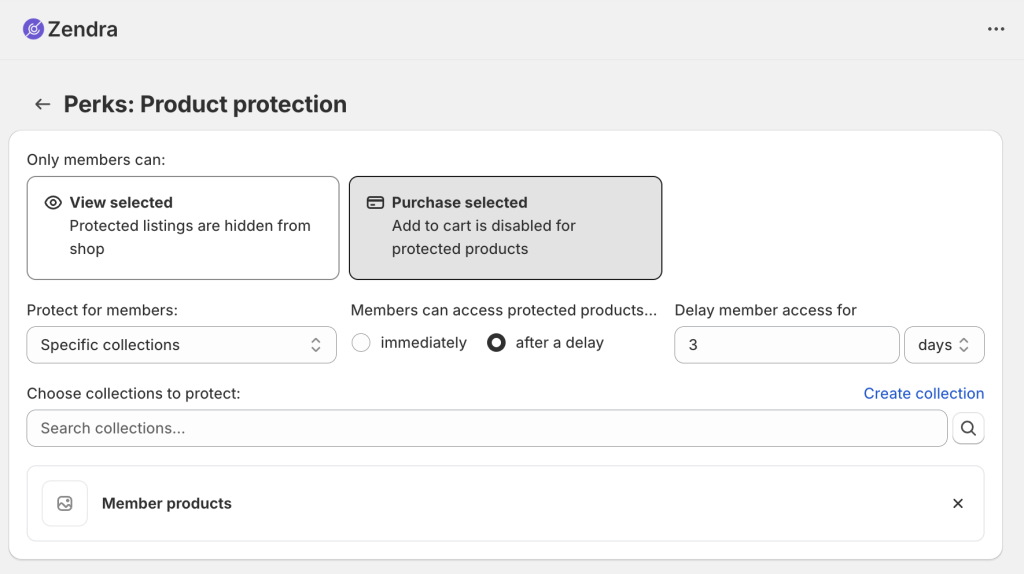
When customers care about the brand itself — not just the product — access reinforces that attachment. It rewards attention rather than price sensitivity.
A balanced approach
Strong membership programs often combine both levers. Gated access forms the foundation, while member discounts are used tactically and intentionally. You can even run member discounts as time-limited sales in Zendra by adding start and end dates, to let your discount double as a type of “access” or exclusivity.
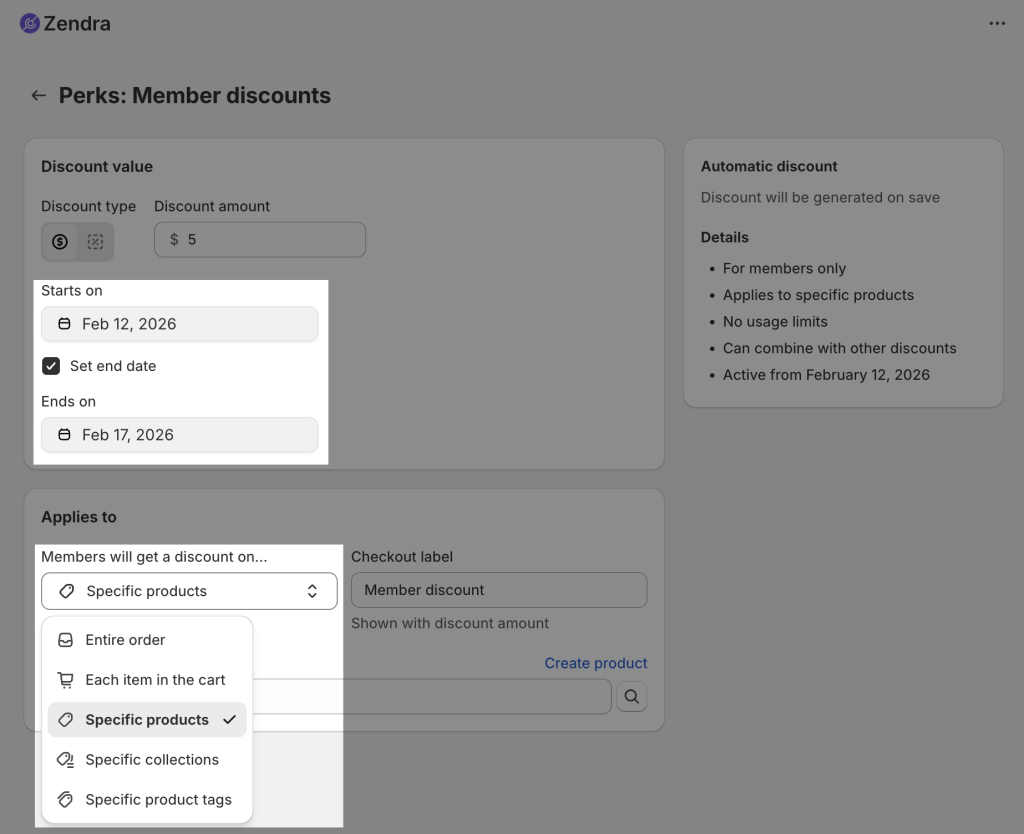
For example, access might be permanent and identity-building, while discounts are temporary and targeted. This preserves margin and prevents customers from anchoring exclusively on price.
The goal isn’t to eliminate discounts — it’s to prevent them from defining the entire relationship.
Design for the behavior you want
If you want customers who return because they value your brand, access is usually the stronger long-term lever. If you want immediate conversion or short-term activation, discounts can be effective.
Repeat purchasing is a behavioral outcome, not a perk. Choose the lever that reinforces the kind of relationship you’re trying to build. Over time, the programs that compound are the ones that build identity first and use price strategically — not the other way around.






Leave a Reply