

Spotify will give a new listener up to three months of Premium for nothing. Someone who had Premium and left gets a different welcome: up to 75 percent off for two months, paid. The fine print on the same offer page adds a rule about the free version, too: if you cancel during a zero-priced trial, you lose Premium immediately, with no way to restart it. (Spotify changes its offers often; those terms are from the page as we read it in October 2026.)
That rule is aimed at a behavior anyone who’s run a trial will recognize. People sign up and cancel right away, to make sure they don’t forget. In RevenueCat’s 2026 data on subscription apps, 55.4 percent of cancellations of three-day trials happened on the first day. Spotify’s terms make that defensive cancel cost something, while its paid offer for returning listeners skips the problem entirely. Free is for strangers, and people who already know the product pay something, even if it isn’t much.
A free trial and a discounted first month (sometimes called a paid trial) look like two sizes of the same favor, but they lower different barriers, invite different people in, and set up different conversations when the first full charge arrives.
A free trial and a discounted first month ask different questions
A free trial asks, “Do you want to see what this is like?” Saying yes costs nothing, so almost anyone curious will. The membership then has a deadline to prove itself before the first charge.
A discounted first month asks, “Will you put a little money behind this?” Fewer people say yes, but the ones who do have already decided to pay you something. The membership’s job shifts from earning a first payment to earning the full price.
The question for your store is which barrier keeps good members out: doubt about whether they’d use the membership, or reluctance to pay before they’ve seen it.
Why $0 brings in a different crowd
People don’t treat zero as a small price; they treat it as a different category. In an experiment by Kristina Shampanier, Nina Mazar, and Dan Ariely, shoppers at a booth in MIT’s student center could buy a Lindt truffle for 15 cents or a Hershey’s Kiss for 1 cent, and 73 percent of those who took a chocolate chose the truffle. When both prices dropped by 1 cent, making the Kiss free, 69 percent took the Kiss instead (Marketing Science, 2007). The gap between the two prices never changed. The researchers traced the shift to emotion: free feels better than the arithmetic says it should, and in a later experiment, asking people to compare the options carefully first made most of the effect disappear.
That pull helps when your main problem is getting people to try the membership at all. It’s also why a free trial attracts some people who were never going to pay. The feeling that got them to sign up doesn’t carry them through a careful decision a few weeks later.
A price, even a small one, works as a filter. When economists Nava Ashraf, James Berry, and Jesse Shapiro sold a water purification product door to door in Zambia at different prices, higher prices screened out the households that would use it less (American Economic Review, 2010). They found no consistent evidence that paying more made buyers use the product more. The price changed who bought, not how they behaved afterward.
Subscription businesses see the same pattern. A study of 16,512 digital TV households found that customers who joined through a free trial were worth 59 percent less over their lifetime than customers who signed up at the regular price (Datta, Foubert, and van Heerde, Journal of Marketing Research, 2015). The same study had a more hopeful finding: free trial customers responded more strongly to marketing and to their own usage, so the gap wasn’t fixed. A trial member who builds a habit can become a good member. The trial just doesn’t guarantee they’ll get there.
How deep a first-month discount should go
If free attracts a less-committed crowd, asking for some money should help. Depth matters, though, and the relationship isn’t a straight line.
Michael Lewis studied new customer discounts at a newspaper and an online grocer, and found that a 35 percent acquisition discount produced customers worth about half as much over time as customers who started at full price (Journal of Marketing Research, 2006). Two insurance field studies added a stranger finding: discounts between 5 and 35 percent raised retention, while discounts above 35 percent lowered it, and so did discounts under 5 percent (Del Rio Olivares and colleagues, Journal of Marketing, 2018).
The researchers’ explanation is about what a discount teaches. A moderate cost cut signals goodwill and makes people expect a relationship, not more discounts. A steep one teaches them to expect the next deal, and a token one doesn’t register as a gesture at all.
Neither study looked at Shopify memberships, so treat 35 percent as a signal rather than a rule! It’s still a good check on a common intro offer — half off the first month — which is also the example in our own discounted first month recipe. “Half off” sits past that point, and may be where a discount stops filtering for members and starts filtering for bargain hunters.
If members who joined at half price renew poorly, test a smaller percentage or a fixed amount before you give up on intro offers. A $1 first month, the classic paid trial, sits at the far end of the same scale: it asks for a card and a decision, but almost no money.
Month two tests each offer differently
For a free trial, month two brings the first payment of any kind, from nothing straight to the full price. Two things make that step easier to clear. The first is whether staying is the default. In Recurly’s data from more than 2,200 subscription businesses, trials that collected billing details up front converted at 40.1 percent, compared with 25.5 percent for trials that didn’t. (The card-required trials were also shorter, averaging 30 days against 60, so trial length may explain part of the gap.) A Zendra trial ends in the first charge automatically, so staying takes no extra step.
The second is whether the trial lasts long enough to reach the moment your membership proves itself. RevenueCat’s data from more than 17,000 subscription apps found that monthly subscribers who converted after a 17 to 32 day trial renewed for a second paid month 77.5 percent of the time, compared with 49.5 percent for subscribers who never had a trial (RevenueCat, 2026). Apps aren’t memberships, and longer trials may attract more deliberate buyers to begin with, so treat it as a hint rather than proof: the members who had time to build a habit were the ones who kept paying. We covered how to match trial length to what you’re testing when trial length became its own setting in Zendra.
For a discounted first month, month two is a price increase. The member has already paid, so the question isn’t whether they’ll pay at all, but whether the full price still feels fair after they’ve seen a lower one. Large subscription businesses plan for this step out loud. The New York Times credited the rise in its digital revenue per subscriber mainly to “subscribers transitioning from promotional to higher prices” (alongside price increases for some longer-term subscribers) in its fourth-quarter 2025 results.
When the discount is limited to the first payment, Shopify’s checkout shows both numbers before the member pays: the discounted first payment on the line item, and the full price under the recurring subtotal. A member who saw the full price before joining experiences month two as the deal they agreed to. A member who didn’t experiences it as a price hike, which is a much harder thing to renew through.
Run the numbers to month six
Here’s an illustration with made-up numbers, to show where each offer wins. Picture a $19 monthly membership with a one-month trial:
- Free trial: 100 people start, and 40 convert. Month one earns nothing, and month two earns $760.
- Half-price first month: asking for money halves the starts to 50, who pay $475 in month one. Thirty-five of them stay at full price, so month two earns $665.
After two months, the discounted offer is ahead, $1,140 to $760. The trial group pays $95 more each month from then on, so the two offers tie at $3,800 at the end of month six, and that tie assumes nobody in either group cancels. Both research threads cut against that assumption. Datta’s free trial customers were worth less over time, and the insurance customers in Del Rio Olivares’s studies renewed less after discounts deeper than 35 percent, which half off is. Whichever group drops off faster loses the race, and only your own renewal data can tell you which one that is.
Your numbers will differ, but the structure won’t: a trial buys a head start in members, a discount buys a head start in revenue, and renewal rates decide which head start lasts.
Match the offer to when your members feel the value
The most practical way to choose is to ask when a new member first feels that joining was worth it.
- Value arrives on the first order. Member pricing, free shipping, and members-only products pay off immediately. A free trial hands them over for nothing, so someone can join, place one large order at member prices, and cancel before the first charge.
A discounted first month asks for something in return, but it can leak value, too. For these programs, a modest discount, a signup fee, or no intro offer at all usually fits better than a trial. If you do offer a trial, access dripping can hold back a discount perk until a member has been around past the trial window. - Value builds over weeks. Content libraries, courses, and perks released on a schedule take time to appreciate, and a trial that ends before the first meaningful unlock asks people to judge something they haven’t seen. A free trial works well here, as long as it runs long enough to reach that moment.
Access dripping can manage that balance: release enough during the trial for people to judge the library, and schedule the deeper material for after the first charge. - Value depends on belonging. In a community membership, the person deciding whether to stay is asking whether these are their people, and that rarely gets settled in a week. A discounted first month gives someone a full month inside, which is closer to the time that question takes, and the small payment does the screening Ashraf’s study describes.
- The person used to be a member. This is Spotify’s split. A former member has already seen what the membership is like, so a trial teaches them nothing new. A paid discount sent only to former members, as a code limited to one use per customer, is a more honest way to say, “Come back.”
Sometimes the right intro offer is none
Netflix stopped offering free trials in the U.S. in 2020, saying it was “looking at different marketing promotions in the United States to attract new members.” At that level of fame, a trial probably subsidized more people who’d already decided than people who needed convincing.
Your store probably isn’t Netflix, but the logic scales down. If you’re inviting customers who have already bought from you several times, an intro offer may only discount a decision they were ready to make. Full price with a strong first week (our onboarding guide covers what that week should include) can serve them better. So can an earned membership that arrives free once a customer reaches a purchase milestone, which skips the question of an intro price entirely.
Set up either offer in Zendra
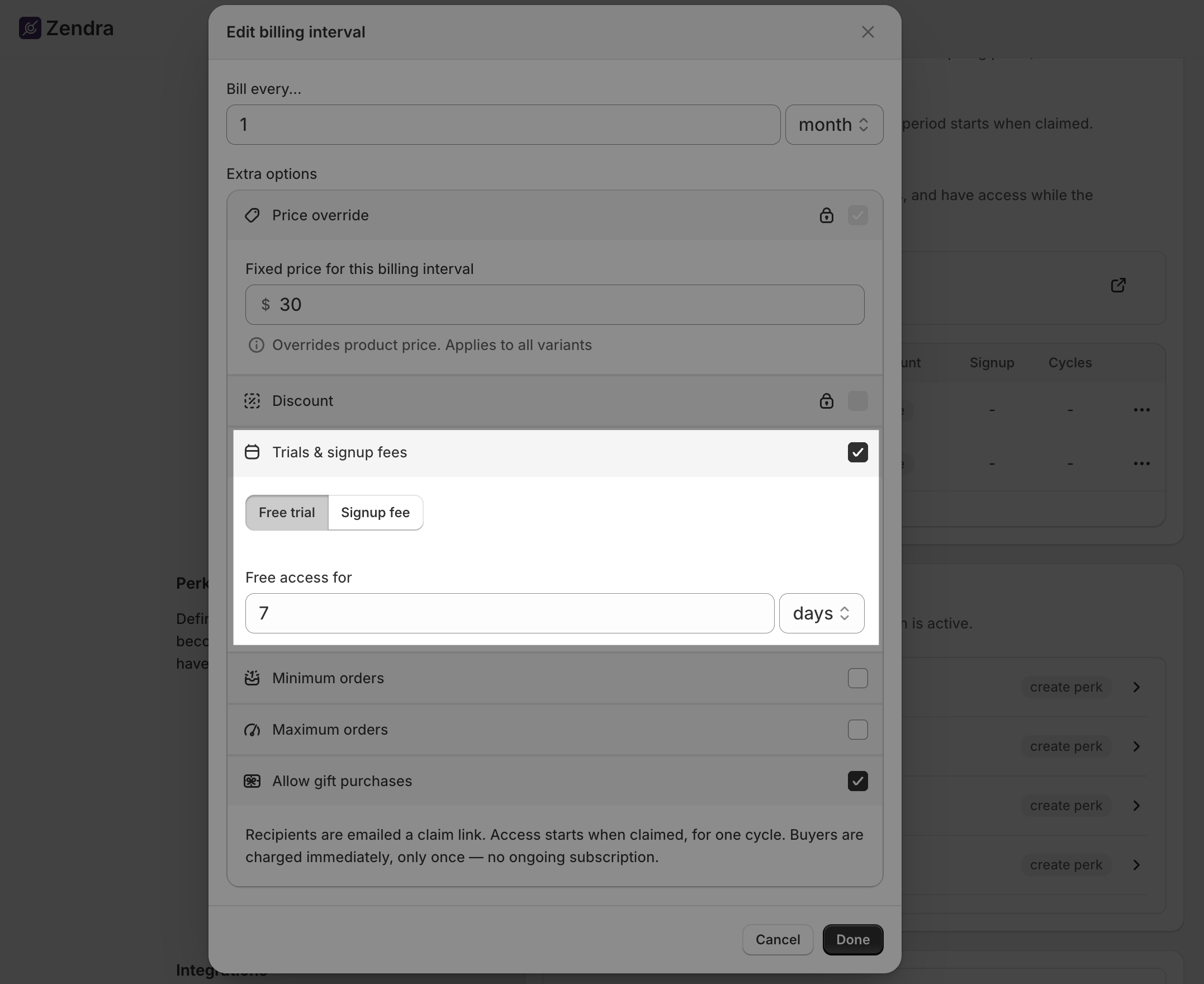
A free trial lives on a billing option in the plan editor. You enter the trial length in days, independent of the billing interval, so a monthly plan can carry a 14-day trial and an annual plan a seven-day one. Free trials, signup fees, and access dripping are all part of the Growth and Plus plans.
A discounted first month doesn’t need a Zendra setting. It’s a Shopify discount that applies to subscriptions and stops after the first payment, so it works on every Zendra plan, including Free. The discounted first month recipe walks through the setup, and three choices in it shape the strategy:
- Under Recurring payments for subscriptions, choose Limit discount to the first payment. Without it, the discount follows the member into every renewal.
- Use a discount code limited to one use per customer so nobody claims the intro price twice, and share it only where new customers will see it. An automatic discount applies to every new subscription, including former members who rejoin.
- If you also sell annual billing, remember that the first payment on an annual plan is a whole year. A fixed amount off, or a code you share only with the audience you’re targeting, keeps the offer from halving a year of revenue.

If you run both offers, or switch from one to the other, compare the cohorts after the second full charge, not the first. In Shopify Flow, Zendra’s Membership Trial Started and Membership Trial Converted triggers can tag trial members when they start and again when they convert, and Shopify’s own Order created trigger can tag customers whose order used the intro code. Membership Renewal Processed and Membership Cancelled then show how each tagged group behaves at full price.
Be clear about what happens after the intro
Spotify’s fine print runs long for a reason: any offer that turns into a recurring charge comes with rules. In the U.S., the Restore Online Shoppers’ Confidence Act requires you to disclose the terms clearly before collecting billing details, get the customer’s express consent before charging, and offer a simple way to cancel. The FTC’s broader “click to cancel” rule was vacated in July 2025 and is back in rulemaking, so the federal picture is still moving. Some states already ask for more: California’s amended automatic renewal law requires a reminder 3 to 21 days before a free or discounted period longer than 31 days ends (California Attorney General). (This isn’t legal advice, so check what applies to your store and the places your members live.)
The law sets a floor. A reminder before the first full charge is also the cheapest way to make sure the decision at month two is about the membership, not about whether someone felt tricked.
Choose the barrier you want to lower
Spotify’s two offers come down to a judgment about what stands between a person and the next payment. For a stranger, it’s doubt, so Spotify lends them time. For someone who has already been a member, it’s commitment, so Spotify asks for a little money and makes the decision feel small.
A Shopify membership faces the same two kinds of hesitation, just with smaller numbers. If good members hesitate because they can’t picture the value, give them a trial long enough to feel it. If they hesitate because joining feels like a bigger commitment than it is, a modest first-month discount makes the first step smaller without pretending the membership is free.
If you’re building an intro offer, Zendra, our Shopify memberships app, supports both, and the discounted first month works on the Free plan.



Leave a Reply