

Amazon Prime is often described as a shipping program.
But shipping isn’t the real innovation.
Prime works because it removes friction from buying. Once customers join, the mental cost of making a purchase drops. Shipping feels free. Delivery feels fast. Buying feels easy.
That shift in experience has measurable impact. Research has repeatedly shown that Prime members spend significantly more than non-members. Consumer Intelligence Research Partners estimates Prime members spend roughly $1,400 per year on Amazon compared to about $600 for non-members (CIRP research).
In other words, the membership doesn’t just reward loyalty — it reshapes purchasing behavior.
Prime didn’t win by discounting. It won by making buying effortless.
The core principle behind Prime-style memberships
Most loyalty programs reward customers after they buy. Prime-style memberships remove friction before they buy. Instead of saying, “thanks for purchasing,” these memberships say, “this will be easier next time.”
Reducing friction is a powerful use of membership perks. You can offer:
- free or discounted shipping
- faster shipping options
- early access to new products
- members-only products
- simplified checkout experiences
Each one removes a small barrier that might otherwise slow a purchase decision. Not only does your brand generate revenue from selling your membership, but it also increases the lifetime value of every single customer.
Friction reduction increases spending
Shipping fees create mental transaction costs
Behavioral economists have long observed that small frictions in purchasing decisions can dramatically affect conversion rates.
Shipping costs are one of the clearest examples. Research has shown that consumers often respond more positively to free shipping than to equivalent discounts because the absence of a fee feels psychologically different from a reduced price (Dan Ariely on the psychology of “free”).
In ecommerce experiments, free shipping frequently increases conversion rates even when the economic value is identical to a discount.
Membership reframes purchasing behavior
Once customers pay for a membership, they begin thinking differently about where they shop.
Research into loyalty programs shows that paid memberships increase switching costs and encourage customers to concentrate spending within the ecosystem that provides the benefits (McKinsey analysis of paid loyalty programs).
Once someone has paid to join, it feels wasteful not to use the benefits. That psychological dynamic helps explain why Prime members spend so much more annually than non-members.
Convenience builds habit
When buying becomes easier, it becomes routine.
Reducing small frictions like shipping costs, delivery uncertainty, or access barriers lowers the cognitive effort required to make a purchase decision. Over time, those small changes accumulate into habit-driven purchasing behavior.
What Prime-style memberships bundle
Prime isn’t built around a single benefit. Instead, it bundles multiple conveniences together:
- free shipping
- faster delivery
- exclusive deals
- members-only products
- digital perks like streaming
Each perk reinforces the perceived value of the membership. Importantly, many of these benefits are small on their own. But together, they create a system where being a member simply feels better than not being one.
Translating Prime-style memberships to Shopify
Independent brands obviously can’t replicate Amazon’s logistics network. But they can apply the same principle: reduce friction for loyal customers.
Common examples include:
- free or discounted shipping for members
- early access to product launches
- members-only collections
- private sales events
- priority customer support
Each perk removes a small barrier that would otherwise slow down repeat purchases.
Example Prime-style membership structure
A Shopify brand might structure a membership like this:
- Membership price: $39 per year
- Member benefits:
- free standard shipping
- early access to product launches
- members-only products
- private sale events
With Zendra, these benefits can be implemented in minutes. Shipping perks can be applied to active members. Product access can be gated by membership. Private sales can be scheduled and restricted to members.
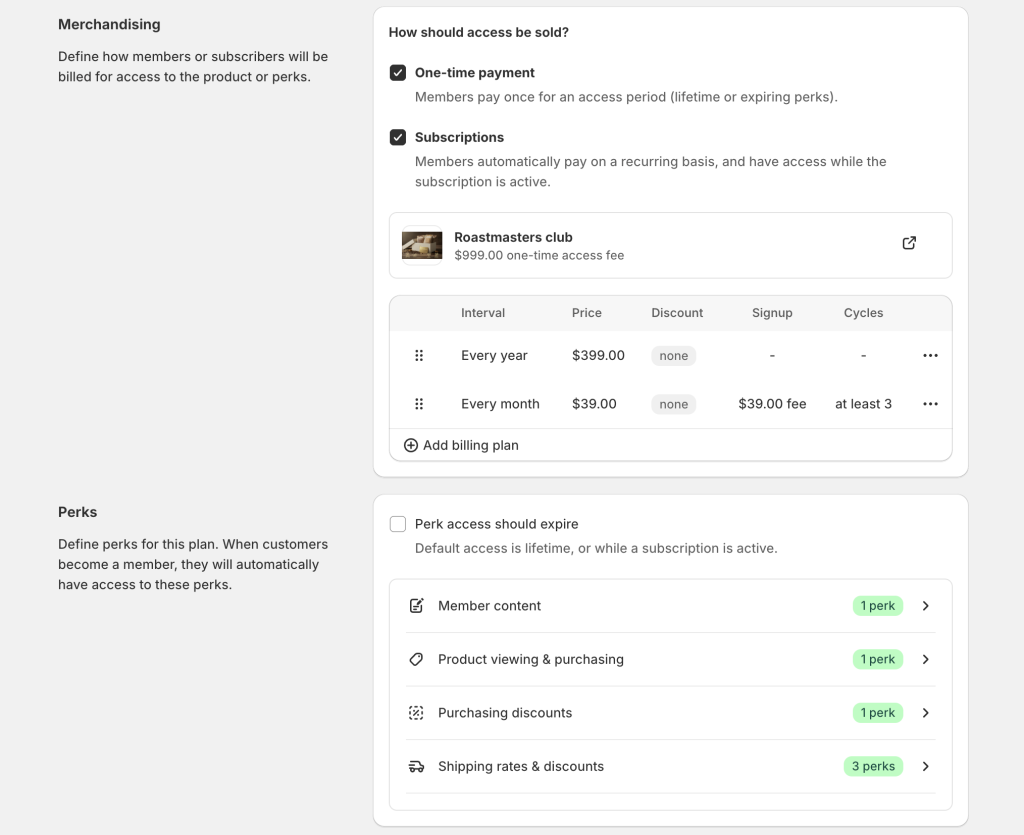
The result is a membership that changes the shopping experience — not just the price.
Why this model protects margins
One advantage of Prime-style programs is that they avoid heavy reliance on discounts.
Discount-driven loyalty programs often train customers to wait for promotions. Friction-reducing memberships instead encourage purchases through convenience and access — closer to why people join memberships in the first place.
Customers aren’t responding to lower prices — they’re responding to a smoother buying experience.
Where this model works best
Prime-style memberships tend to work best when customers already have reasons to come back.
- High-frequency retail. When customers buy regularly, removing friction compounds over time. Shipping perks and early access reduce barriers that might otherwise send shoppers to competitors.
- Product launch-driven brands. Brands that release new products frequently can use early-access perks to reward members and concentrate demand among loyal customers.
- Lifestyle brands. When customers identify with a brand, membership perks feel less like promotions and more like belonging.
If your store fits one of those profiles, here’s how to start your own membership program.
Loyalty without discount addiction
Prime-style memberships highlight an important lesson: Loyalty doesn’t need to be built on discounts. Often, it’s built on convenience.
When membership removes friction from the buying experience, customers come back more often — and spend more when they do.



Leave a Reply