

Most membership programs start the same way: someone opens a blank document or grabs a whiteboard marker, writes Member benefits across the top, and almost instinctively adds the first bullet:
- 10 percent off.
It’s such a common starting point that it barely feels like a decision. Members should get a discount. That’s what memberships are for, right?
On the surface, it makes perfect sense. Discounts are easy to explain, easy to calculate, and easy to launch. They create immediate value for customers, and they require little imagination from the merchant. Before you’ve designed exclusive products, written premium content, or built a community, you can always promise a percentage off.
But look at the memberships people are happiest to pay for: Costco, Amazon Prime, REI Co-op, a favorite museum, a local climbing gym, a coffee subscription, or a creator’s Patreon. Now imagine each one disappeared tomorrow. What would you miss?
For most people, the answer isn’t simply, “I would miss saving 10 percent.” They’d miss the free shipping that made shopping effortless, the early product releases, the members-only events, the feeling of being on the inside, the habit they no longer had to think about, or the identity they’d attached to the brand. They’d miss everything outside of the arithmetic.
That’s because the reward that convinces someone to join isn’t always the reward that convinces them to stay. Yet many membership programs are designed as though the discount is the main attraction. Merchants spend months debating the percentage discount while their customers are asking a more important question. A discount prompts, “Is this the cheapest place to buy?”, but a great membership asks, “Why would I buy this anywhere else?”
The distinction sounds subtle, but it changes almost everything about how a membership behaves. Discounts compete on price, but memberships compete on relationships. Those aren’t the same game.
Why discounts are every merchant’s first idea
We can easily criticize discounts from the comfort of hindsight; it’s harder to acknowledge why nearly every merchant starts there. Discounts solve several problems at once: they’re immediately understandable, operationally simple, measurable, and available on day one. Customers don’t need an explanation, and merchants don’t need exclusive inventory, gated content, or a community platform to make the offer real.
But there’s another reason discounts are so attractive: they’re easy for us to think about. Membership planning usually happens in a world of spreadsheets, margins, average order value, lifetime value, and contribution profit. A discount fits neatly into that world because it’s quantifiable. You can calculate the cost of 15 percent off down to the penny.
“Belonging” doesn’t fit in a spreadsheet quite so cleanly. Neither does identity, recognition, or becoming someone’s default choice. Those outcomes are harder to measure, which can make them feel less real, even when they’re far more durable.
Customers, meanwhile, don’t experience your business as a spreadsheet. They experience it as a series of tiny decisions: Should I buy from this brand or another one? Should I wait for a sale? Should I look somewhere else first? Each time one of those questions appears, your membership either removes the decision or creates another one.
Once price becomes the primary reason someone joins, it has a habit of becoming the primary reason they leave.
That’s the hidden cost of leading with discounts. A discount doesn’t eliminate the comparison; it simply changes the number being compared. The customer no longer asks whether they should buy from you; they ask whether your 10 percent beats someone else’s 15 percent. It’s still a price conversation, and once price becomes the primary reason someone joins, it has a habit of becoming the primary reason they leave. There’s a reference-price problem underneath this, too: initial anchors quietly reshape what customers judge later prices against (St. Louis Fed).
We dug into that mechanism in more detail in why your membership should be more than a discount.
Memberships change decisions, not purchases
Imagine two coffee companies. Both roast excellent coffee, charge about the same price, ship nationwide, and have loyal customers. One sends a coupon every few weeks. The other offers a membership with early access to limited roasts, a standing subscription with free shipping, members-only tasting notes, and invitations to live roasting sessions.
The products aren’t dramatically different, and the customers probably aren’t either. What changes is the conversation happening inside the customer’s head when the coffee runs low.
The coupon customer still has to make the purchase decision from scratch: Should I buy here? Is there a better deal somewhere else? Should I wait until next week? Those questions never disappear. Sometimes your discount wins, and sometimes someone else’s does.
The membership customer is asking a different question: Which roast should I get this month? They’re no longer deciding whether to buy from you. They’re deciding what to buy from you. That sounds like a small distinction, but it’s one of the most valuable shifts a business can create.
People rarely optimize every familiar choice from first principles. We build habits, establish defaults, and create routines that save our attention for decisions that matter more. You probably don’t research a new grocery store every week, reevaluate every streaming service each Friday night, or comparison-shop every tube of toothpaste. Not because better options never exist, but because constantly reconsidering familiar decisions is exhausting.
The best memberships understand this intuitively. They aren’t trying to win every purchase as though each one were a fresh contest. They’re trying to stop every purchase from becoming a debate.
A discount competes with every other discount in the market. A membership competes with inertia.
Once you start looking through that lens, the world’s best membership programs begin to look surprisingly similar. Costco isn’t Patreon. A neighborhood climbing gym has almost nothing in common with a specialty coffee subscription. Yet they reduce uncertainty in some form: uncertainty about what you can access, where you belong, or what you should do next.
Why people join memberships in the first place
You’re probably tempted to search for a single explanation: People join because they like discounts. People join because they want to belong. People join because they’re loyal. Reality is messier than any one of those explanations.
Different memberships satisfy different needs. But across warehouse clubs, museums, creators, gyms, and Shopify brands, three motivations appear repeatedly:
- Access. Members gain something they couldn’t otherwise have.
- Identity. Members become a particular kind of customer.
- Default. Members stop wondering whether they should come back.
Notice what’s missing from that list: price. That’s not because discounts never matter — they clearly do! But enduring memberships tend to offer something more durable than a better transaction, and behavior follows. McKinsey found that members of paid loyalty programs are 60 percent more likely to spend more on a brand after subscribing, while free programs move that number to roughly 30 percent.
People pay for access long before they pay for savings
Ask someone why they subscribe to a creator on Patreon, join a museum, pay for a private Discord community, or remain in an enthusiast coffee club. The answer is rarely that they’re optimizing for price — they’re paying because membership unlocks something.
Sometimes the access is obvious: exclusive products, early releases, premium content, private events, or members-only spaces. Sometimes it’s subtler. Buying from the same butcher every week means someone quietly saves your favorite cut for when you come in. Visiting the same neighborhood café means your drink is already being made before you get to the register. Returning to the same video game store means the owner tells you about the next tournament before it’s announced publicly.
None of those businesses necessarily calls this “exclusive access,” but that’s exactly what it is. Membership formalizes something humans have valued for centuries: being on the inside. That’s why the strongest access perks don’t feel like coupons; they feel like doors. It’s the same mechanism we traced through Nike’s membership program, where early access to product does more work than any price cut would.
Access also ages better than discounts. A competitor can always offer a bigger coupon. They can’t offer access to your products, your community, your expertise, or your relationship with customers. Good access compounds because it’s difficult to copy, which is the heart of the difference between member discounts and member access.
Identity changes how customers see themselves
Access explains why someone joins. Identity helps explain why they defend the decision.
Spend enough time around Costco members and you’ll notice something unusual: people don’t merely tolerate the annual fee. They recommend it, often passionately. Ask why, and they may start listing prices. The gas alone pays for it, and then there are the rotisserie chickens and the paper towels. They’re probably right, but something deeper is happening.
Once someone voluntarily pays to belong, that membership can become part of how they think about themselves. They’re no longer merely someone who shops at Costco. They’re a Costco member. That sounds like semantics, but identity shapes behavior in durable ways. REI’s co-op model is probably the cleanest retail example of this: the dividend is real, but the membership is doing identity work the dividend never could.
Membership therefore does more than reward purchases. It creates a relationship the customer wants to remain consistent with. That’s why the fee itself can matter: paying turns a casual preference into a declared commitment. Status that has to be earned rather than purchased pushes the same lever even harder.
A competitor can beat your price for a weekend. It’s much harder for them to convince your members that they belong somewhere else.
The best memberships become the default
The third motivation is easy to overlook because it rarely appears on a feature list. No one advertises, “Join now and eliminate one recurring decision from your life.” Yet that’s exactly what many of the world’s best memberships accomplish.
Prime members don’t believe Amazon has the lowest price on every product, the best customer service, or the highest-quality option in every category. They know it doesn’t. None of that prevents Prime from becoming the first place they look for batteries, dog food, or a phone charger.
The decision is no longer, “Where should I buy this?” It’s, “Which one should I buy?” Prime changed the default, and the mechanics of that shift are worth studying even if you’ll never operate at that scale — we broke them down in how to build a Prime-style membership without being Amazon.
The remarkable thing about defaults is that customers often don’t notice they’ve formed one. A purchase goes well, then another. Shipping is reliable. Returns are painless. The membership pays for itself. Months later, opening Amazon feels less like making a decision and more like continuing a habit.
That gradual shift is valuable because you’re no longer winning only when you offer the best deal today. You’re winning because customers have stopped asking whether they should buy from you in the first place. The strongest memberships don’t make customers more loyal; they make loyalty require less effort.
This is also why subscriptions can feel so sticky. Without a coffee membership, each month begins with the same question: Where should I order coffee this time? With a subscription, the question becomes: I wonder which roast is arriving next. The purchase didn’t necessarily become cheaper. It became easier — an underrated competitive advantage. Sometimes a competitive moat is the simple fact that another brand has already become the customer’s routine. Leaving that brand doesn’t just mean giving something up; it means rebuilding a habit.
Taken together, access, identity, and default explain why the best memberships are resilient. None is primarily about saving money. All three make the relationship more valuable than the next transaction.
Every reward teaches customers what to value
None of this means discounts are bad. That would be an easy caricature, and it would be wrong. Discounts work. They increase conversion, create urgency, help clear inventory, and lower the risk of trying something new. Entire retail businesses have been built around offering lower prices than everyone else.
The question isn’t whether discounts work. It’s what they teach.
Every incentive carries an implicit message. A members-only event says, “This community is worth being part of.” Early product access says, “Being here gets you opportunities other people don’t have.” A milestone reward says, “The longer we know each other, the better this relationship becomes.”
A permanent percentage discount sends a message too: “The most important thing about this membership is that things cost less.” That may be a perfectly reasonable lesson to teach if lower prices are genuinely your competitive advantage. But many brands spend years investing in craftsmanship, service, storytelling, education, or community, only to make price the centerpiece of their membership.
Customers tend to believe us when we tell them what matters. If every email leads with a percentage, they’ll conclude the percentage is the point. If every announcement celebrates another sale, they’ll learn that waiting is part of the experience.
The strongest memberships don’t ask, “How can we make buying cheaper?” They ask, “What becomes more valuable because you’re a member?”
Incentives can reshape motivation, and psychologists have a name for the risk. In the classic overjustification studies, children who expected a reward for an activity they already enjoyed showed measurably less interest in that activity later, once the reward was gone — the external reason had displaced the internal one (Lepper and Greene, 1975).
Suppose someone originally joined because they loved your products, valued your expertise, and wanted to support your business. Now imagine that every interaction reminds them of one thing: 10 percent off. Over time, what’s easiest to remember: the craftsmanship, the community, or the discount?
Even a satisfied customer can begin evaluating the membership through the lens you’ve handed them. The question shifts from, “Do I still want to be part of this?” to, “Am I still getting enough value to justify the fee?”
Those aren’t the same question. One asks whether the relationship matters. The other asks whether the math still works. Math is easy for competitors to change, while relationships are much harder.
When discounts are exactly the right answer
After all of this, it would be easy to conclude that memberships should never include discounts. That would also be a mistake, and the overjustification researchers said much the same thing about rewards generally. Their own conclusion was not that extrinsic rewards should be abandoned, but that anyone hoping to sustain interest when the reward isn’t present should use the smallest amount of external pressure that does the job.
Discounts are one of the oldest incentives in commerce because they’re effective. They reduce friction, reward repeat purchases, and can make a membership feel as though it pays for itself quickly. The problem isn’t offering discounts. It’s asking them to do a job they were never designed to do.
A discount can encourage someone to join. It rarely gives them a reason to care.
Prime uses shipping benefits to reinforce convenience. REI pairs financial rewards with a shared outdoor identity. A neighborhood brewery may offer discounted pours, but the deeper attraction is becoming a regular whose name everyone knows — the same dynamic that makes a genuine member community so hard for competitors to replicate. A Shopify brand may offer member pricing, while the real experience is built around exclusive products, early access, education, or a shared point of view.
In each case, the discount supports the membership. It isn’t the membership.
A useful test is to imagine the program disappearing tomorrow. What would members say they lost? If the honest answer is only, “10 percent off,” the program may be easier to replace than you think. If they’d lose access to products, people, status, expertise, or a routine that makes shopping easier, you’ve built something more durable.
How good programs lose people anyway
Plenty of programs get the premise right and still leak members, usually in predictable ways. The same McKinsey research found that half of all cancellations happen within the first year, and the most common reason members gave was that they hadn’t used the benefits enough to justify the ongoing cost — an engagement problem wearing a price-tag disguise. This is a program design problem more often than it’s a value problem, and it tends to show up in one of four ways.
- The perk arrives once and never again. A welcome gift or a joining discount gets spent in the first week, and nothing accumulates afterward, so a member who leaves in month six gives up nothing they can feel. Give at least one benefit that compounds: a tier that improves, credit that builds, or access that widens the longer someone stays.
- Members can’t see what they have. Invisible value is unvalued value, and a member who has forgotten a perk exists is quietly weighing your fee against nothing. Put the full list somewhere they already go, like the account portal or the renewal email, so the value is legible at exactly the moment they’re deciding whether to continue. Our advanced member portal does this for you automatically.
- Joining is the only milestone. If day one is the peak of the experience, there’s nothing left to move toward, and the relationship flattens into a subscription that’s easy to reconsider. Milestone rewards and earned tiers give members somewhere to go next.
- The program is run as a campaign, not a system. Campaigns have end dates and need someone to keep launching them; memberships are supposed to compound while you’re busy with something else. If the program only works when a person remembers to run it, it will stop working the first quarter that gets busy.
None of these issues are fixed by a bigger discount, they’re fixed by structure.
What this looks like on a Shopify store
The ideas above are portable, but they have to land as actual configuration somewhere. On Shopify, a first version of this doesn’t need to be elaborate. It needs three things: a low-friction way in, one perk for access rather than price, and one thing that accrues over time.
For the way in, a free membership plan is usually the right starting point. Zendra can grant a membership automatically to every customer who creates an account, or you can add one manually from a customer’s page in Shopify when you want to hand-pick the first cohort. Nobody has to buy anything to become a member, which means the program starts collecting members before it has to prove its value.
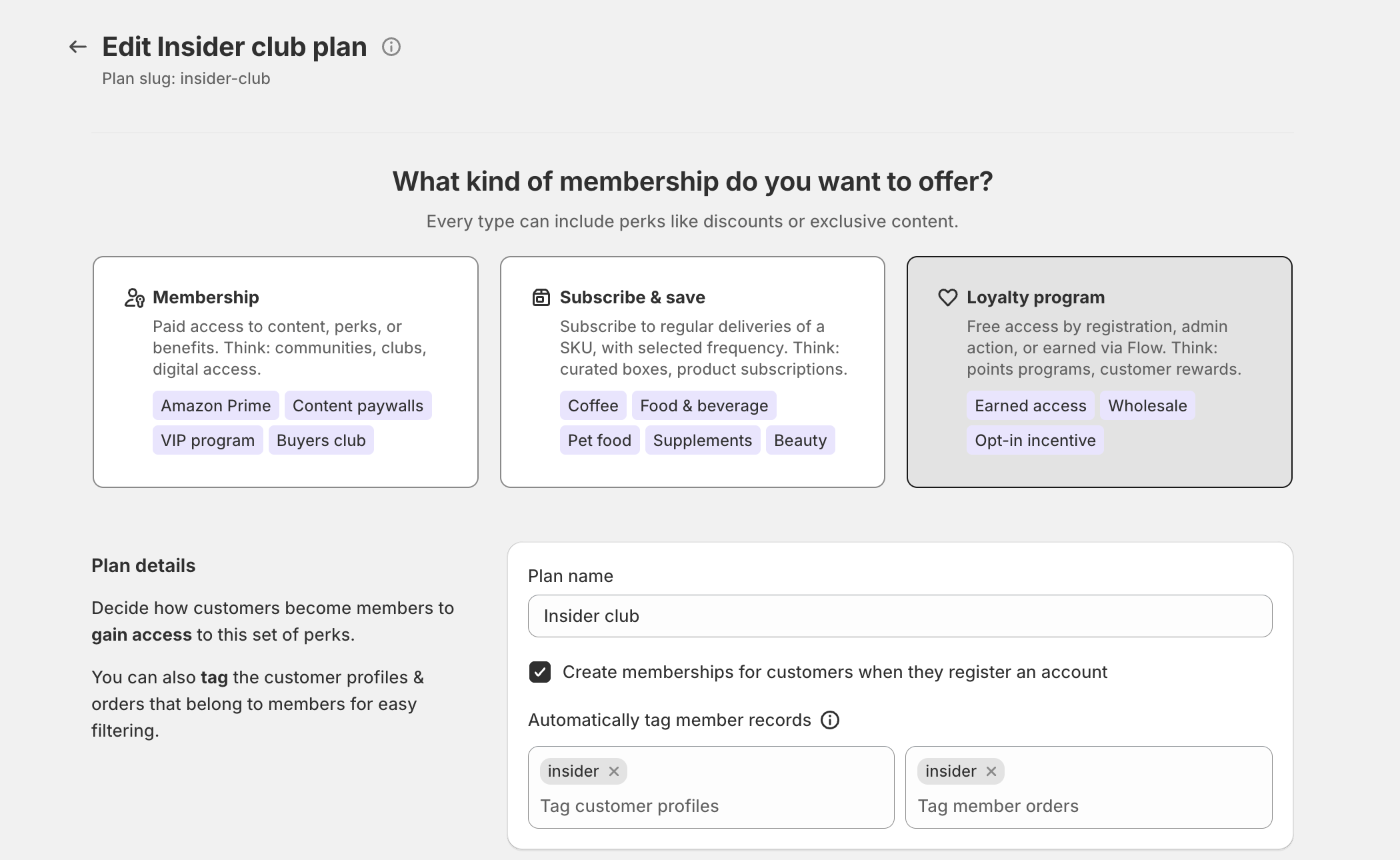
For the access perk, you have a few options that feel meaningfully different to the customer:
- Members-only products hide a product from non-members entirely, so the catalog itself is different depending on who’s looking.
- Purchase restrictions let anyone see the product but only members buy it, which creates visible scarcity rather than hidden scarcity. This is the version that makes non-members aware they’re outside something.
- Content gating restricts a post or page to members while showing everyone else a teaser and a way to join.

For the thing that accrues, access dripping releases benefits on a schedule measured from each member’s join date, so a membership at month three contains more than it did on day one. Perk scheduling lets a member sale open and close on set dates instead of running as a permanent percentage — an event rather than a standing expectation.

Then make it visible, because the second failure mode above is the one merchants underestimate most. Zendra’s customer portal gives members a perks overview listing everything their plan includes, which is the easy fix for value that members have quietly forgotten they’re paying for.

Membership status also syncs to customer tags and Shopify segments, so recognition can travel into your email and support tooling. If community is genuinely part of your brand, Discord roles can be assigned and revoked automatically alongside the membership itself.
Where this thinking fits, and where it doesn’t
Memberships aren’t universally the right instrument, and the conditions that make them work are specific.
- They fit well when your catalog changes — when you launch in waves, refresh seasonally, or release limited runs, because that gives access something to actually be access to.
- They fit when repeat purchase is plausible on a timescale that matters, since a program built around habit needs the habit to be possible.
- Publishers and content creators have a natural fit for memberships, since there’s something new to access or content member scan unlock over time.
- And they fit when your brand carries enough identity that being inside it means something to the person on the other end. If customers already describe themselves using your brand, you have most of the raw material.
They fit poorly in the opposite conditions. A small, static catalog gives you very little to gate, and gating it anyway just makes the store feel smaller. A genuinely once-in-a-lifetime purchase has no second decision to influence. And if price is authentically your differentiator — if being the cheapest is the promise of the business — then a membership dressed up as belonging is worse than being confidently cheap.
Design memberships around relationships, not transactions
When merchants brainstorm membership benefits, it’s natural to start with features: free shipping, member pricing, exclusive products, early access, or private content. That’s useful, but it starts in the middle. A better question comes first: how should becoming a member change the relationship someone has with our business?
Every benefit should answer that question. Does it give members access they couldn’t otherwise have? Does it strengthen their identity as part of your brand? Does it make your business the obvious default the next time they need what you sell?
If the answer to at least one of those questions is yes, you’re probably designing a membership. If the answer is simply, “It makes things cheaper,” you’re probably designing a promotion.
There’s nothing wrong with promotions. They’re just solving a different problem. Promotions win today’s purchase, but memberships influence the purchases that come after it.
That’s why the best membership programs do more than improve conversion rates; they reshape customer behavior.
Whether you’re building a paid membership, a free VIP club, or a subscription program on Shopify, the distinction is worth remembering. The goal isn’t to make every order cheaper. It’s to make the next decision easier. If you’re ready to turn that into an actual program, our guide to starting a membership program on Shopify walks through the structural decisions, and Zendra, our Shopify memberships app, handles the gating, tiers, and lifecycle once you’ve made them.
Great memberships don’t win every purchase. They eliminate the question of where to purchase.




Leave a Reply