

Why do subscriptions feel so reassuring? Partly because they change the emotional weather of the first day of the month. Instead of opening at zero and buying your way back to last month’s number, you begin with a balance already on the board. Revenue feels less like a fresh negotiation and more like a floor.
That floor is real, but predictable and bigger are different promises. A subscription does not automatically change how much you earn; it changes what you are paid for. A one-time sale rewards you for finding a buyer. A subscription rewards you for remaining useful to that person, period after period.
The trade is appealing because finding the buyer has become expensive. In 2022, McKinsey reported that customer acquisition costs had risen an average of 60 percent over five years. When each new relationship costs more to begin, earning more from the customers who already chose you is a sensible response. Recurring revenue is the clearest version of that bet.
And it is a bet with a number attached. Can you keep a member long enough to earn back what it cost to find them, then create enough value for both of you to keep choosing the relationship? Four calculations answer the business half of that question, using your own Shopify data and a calculator. Sometimes the result will be that recurring revenue does not suit your store. That is useful knowledge, too!
Why recurring revenue changes the relationship
Three things change at once. The third is easy to miss because it looks like a marketing concern until the spreadsheet reveals otherwise.
- Revenue becomes a balance you can lose. One-time sales are independent events; a bad March does not reach back and undo February. Subscription revenue carries the relationship forward: this month is last month, plus the people who joined, minus the people who left. Growth becomes the net of two flows — joins and departures — which means a store can recruit harder every month and still shrink.
- The costs recur with it. Whatever you promised this month, you owe again next month: goods, shipping, support, and the software that runs the program. The revenue line repeats, but so does the cost line beneath it.
- Retention stops being a marketing goal and becomes the product. In a one-time business, a customer who never returns is a missed opportunity. In a subscription business, a departure means the relationship stopped producing the months of revenue you priced acquisition against. Sometimes the promise stopped feeling worthwhile; sometimes a payment simply failed.
This is why the psychology matters as much as the billing engine. People join and stay for access, identity, and relief from deciding, not only for the price. If the program misunderstands what members came for, a flawless checkout merely gets them into the wrong relationship faster. So what does keeping someone — and continuing to deserve their attention — do to the numbers?
Churn sets the ceiling on everything else
Start with churn, because every other figure in a subscription business lives downstream of it. Monthly churn is the share of members present at the start of a month who are gone by the end: cancellations (plus failed-payment lapses), divided by the active-member count you opened with. If March begins with 400 active members and 22 leave, March churn is 5.5 percent.
A percentage becomes much easier to feel when you turn it into time. If the rate holds steady, average member lifetime is roughly one divided by the monthly churn rate.
| Monthly churn | Average member lifetime |
|---|---|
| 3% | 33 months |
| 5% | 20 months |
| 8% | 12.5 months |
| 12% | 8.3 months |
Keep two cautions beside that shortcut. First, it assumes a flat rate, while real groups of new members tend to leave fastest in the first period and settle afterward. A leaky first month can hide inside a flattering blended average, so follow one month’s joiners for six months instead of trusting the pooled figure alone. Second, annual churn is not monthly churn multiplied by 12 because the base gets smaller as people leave. Recurly’s benchmark research notes that 2 percent monthly churn compounds to roughly 22 percent annually, not 24.
Churn sets the ceiling because it limits how long the relationship can contribute. So what is one member worth over that lifetime?
What is a member worth over time?
A member’s value is not simply what they pay. It is what remains after you keep your side of the promise, repeated for as long as they stay. In the spreadsheet, that becomes contribution per period multiplied by average lifetime.
Use an illustration with every input visible, then swap in your own. A $25 monthly plan with $10 in goods and shipping leaves $15 of contribution per member each month. At 5 percent monthly churn, the average member stays 20 months. Fifteen dollars multiplied by 20 months gives you $300 of lifetime contribution.
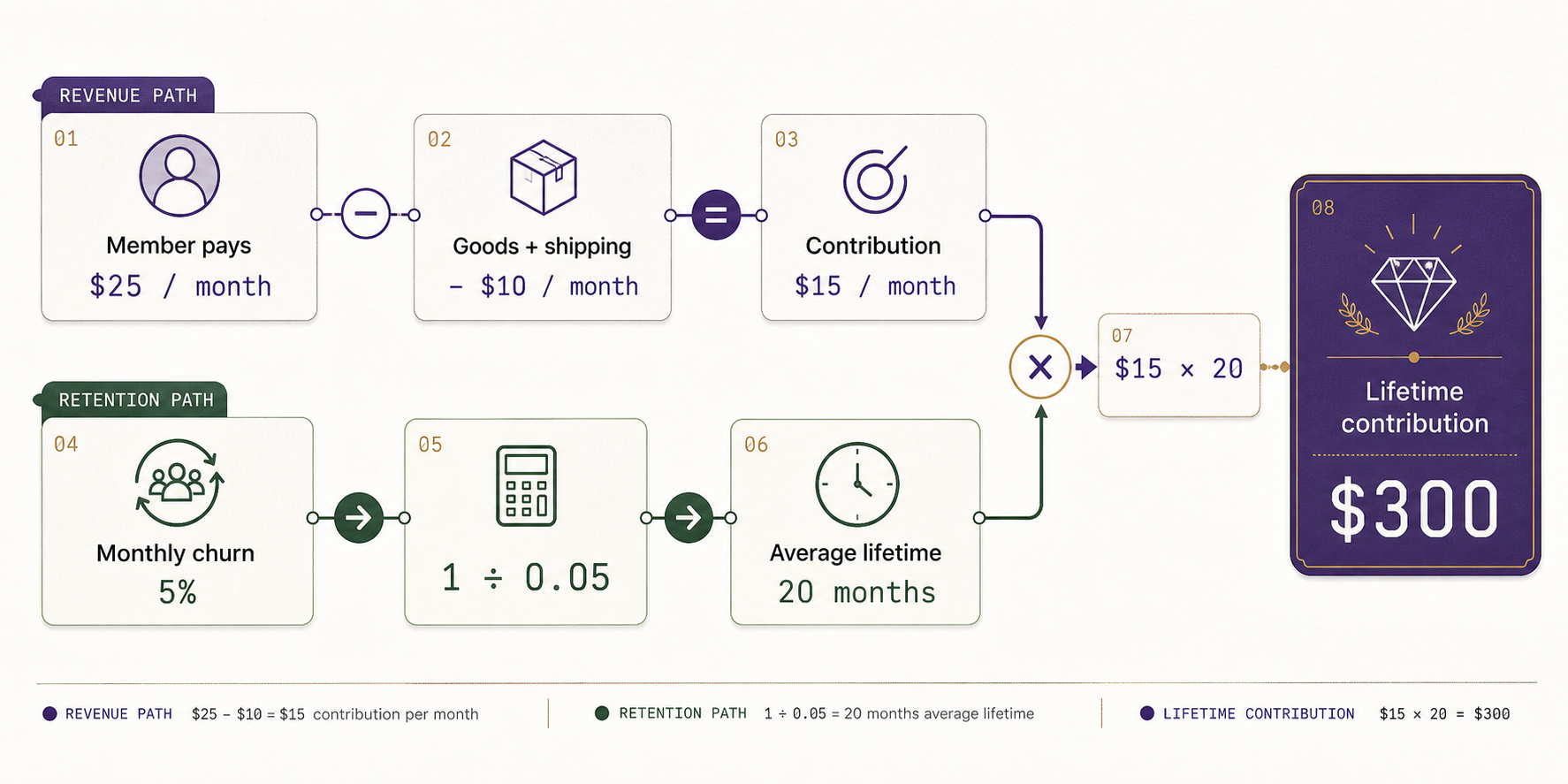
Now move one input and notice how sensitive the result becomes. Keep the price and costs steady, but raise churn to 8 percent, and the same member is worth $188. Lower churn to 3 percent and they are worth $500. The offer has not changed; only how long people continue to choose it has.
The margin term is where the design of the membership becomes visible in the economics. Early access to a drop, gated content, a members-only product, or an exclusive shipping option can feel valuable without costing the same amount every time a member uses it.
Discounts behave differently because each use comes directly out of the margin term. That is why access perks and member discounts produce different economics even when members enjoy both. Neither is inherently wrong; they are simply funded from different places. If your margins are already tight, decide what to charge and what that price has to fund before the program makes the decision for you.
How long does acquisition take to earn back?
A member who contributes $300 is only good news in relation to what it cost to find them. Two numbers close that loop.
Acquisition cost is everything you spent attracting members during a period, divided by the number who joined. Payback is acquisition cost divided by contribution per period; it tells you how long someone must stay before the relationship has paid back its beginning. In our illustration, $60 in acquisition cost divided by $15 in monthly contribution gives a four-month payback. Against a 20-month average lifetime, that is five times the acquisition cost back — but only for members who behave like the average.
Recurring revenue makes the starting balance more predictable. Keeping it means remaining worth choosing.
Payback needs to sit comfortably inside average lifetime, with room for the months when acquisition gets more expensive or early churn rises. It’s also a cash problem before it becomes a profit story: you spend the $60 today and collect the $15 over nearly two years. A store adding 50 members a month on those numbers spends $3,000 now to collect $15,000 slowly. That can be a good trade, and a demanding one at the same time. Growth widens the cash gap before it closes it.
The member who never activates is your most expensive one
Which member costs you the most? It is not the one who cancels after two years; at $15 a month against $60 in acquisition cost, they paid for themselves six times over. It is the person who joins, pays twice, never uses a perk, and quietly leaves.
Run that member through the same illustration: $30 in contribution against $60 in acquisition cost leaves you $30 short, plus the work of onboarding them. Ten members like that create a $300 hole that the revenue chart disguises; it records the two payments and says nothing about the 18 that never happened. A member who never reaches the value they joined for is the costliest outcome in a subscription business — and the only one that resembles a small win while it unfolds.
The data and member experience tell the same story: early engagement matters. Recurly found that weak onboarding and slow value delivery drive voluntary cancellations. A member may decide to leave during their first billing period, even if they don’t cancel until month nine. By then, a last-minute discount is trying to change a decision they made in week two.
So, the first period deserves as much design attention as the offer itself.
- Let members experience value before the first charge. A free trial gives someone time to reach the perk before the card is charged. In Zendra, trial length is separate from the billing interval, so a 14-day trial can sit in front of an annual plan. Trials are available from the Starter plan up.
- Create a reason to return in week three. Access dripping releases benefits on a schedule relative to each member’s join date. The program can reveal something new after the welcome email instead of emptying every promise onto day one. Access dripping is available on the Growth plan and above.
- Make the value easy to find again. Members can browse everything their plan includes from the perks section of their Shopify customer account. A promise they half-remember becomes something they can use. The perks overview comes with the Growth plan.
- Mark the moments that matter. Zendra sends eight lifecycle emails — activation, renewal, upcoming renewal reminder, payment failure, cancellation, expiry, ending soon, and a re-subscribe reminder. Each is editable in Liquid with its own send delay, so the reminder can arrive before the charge rather than after the complaint.
- Notice members before they become former members. Churn risk detection flags memberships approaching expiry based on time elapsed or days remaining. That gives you a chance to act while the relationship still exists.

The same logic applies before someone joins. A first purchase is a moment of unusually high attention, which is why inviting first-time buyers into membership then can make more sense than recruiting them cold three months later. If the math works and you are ready to decide what the program should contain, how to start a membership program on Shopify walks through those design decisions.
Monthly and annual billing are two different businesses
A plan can keep the same perks and attract the same members, yet become a different business when the billing interval changes. The interval decides how often the member revisits the choice — and how often your cash flow has to survive that decision.
The crossover takes one division. Annual price divided by monthly price tells you how long a monthly member must stay to equal one annual payment. At $25 a month and $250 a year, the crossover is 10 months. If average member lifetime is shorter than that, annual billing collects more before the member faces another decision. If a member stays through an 11th monthly charge, monthly billing collects more — but that requires 10 renewals after the initial purchase.
Annual billing removes 11 renewal decisions and 11 card charges that could decline, but it concentrates the relationship into one consequential anniversary. Recurly observes that annual plans carry higher lifetime value while introducing a high-risk renewal milestone. If a member leaves at month 12, you never saw the smaller signals that might have appeared along the way; monthly billing gives you 11 chances to notice someone drifting. Annual billing also asks for a much larger first act of trust. Two hundred fifty dollars is a purchase decision; $25 is a trial of your value. That is why an annual plan usually needs a stronger reason to exist than “two months free.” Costco’s annual fee is the most-studied version of that reason: the fee is not merely a toll on shopping, but part of what makes the shopping feel worthwhile.
Zendra supports weekly, monthly, annual, and custom billing intervals on every plan, so you can choose the cadence that best fits the promise you are making. Two related settings sit on paid plans. A signup fee adds a one-time charge at enrollment (Starter and up), which can fund the first month’s delivery costs without permanently raising the recurring price. A minimum billing cycle requires a set number of payments before cancellation is available (Growth and up). That commitment can be fair when the promised value genuinely takes three months to arrive; when it does not, the same setting turns a weak offer into a trap. Use it only for the first case.
Failed payments are churn you never earned
Not every departure is a rejection. A card expires, a bank declines an unfamiliar renewal, or a balance runs short on the wrong Tuesday. The member did not decide to leave and may not realize that they have.
In Recurly’s July 2026 network data, involuntary churn accounts for roughly a third of ecommerce subscription churn. It falls especially hard on the price points where many Shopify programs live: subscribers in the $10 to $25 band show more than seven times the involuntary churn of subscribers paying over $250. A low price makes a subscription easy to join, but it can also make the charge easy to overlook when something goes wrong.
Recovery is unglamorous and mostly mechanical: retry the charge on a schedule, explain what happened, and let the member replace a card without starting an email thread. Zendra handles that sequence automatically. A failed attempt pauses the subscription, notifies the member, and retries; permanent failure arrives only after the retries are exhausted. A successful retry reactivates both the subscription and membership. Members can view and update their payment method from their Shopify customer account, turning a support ticket into a two-minute fix. When someone chooses to cancel, they keep access through the period they already paid for. Even the ending respects the bargain.
When recurring revenue is the wrong answer
Sometimes the arithmetic comes back with a useful answer: don’t build the subscription. Four situations should make you pause before launch.
- Your catalog has no natural rhythm. A coffee roaster has replenishment built into the product; a furniture store does not. Ask what a member receives in month four. If the answer requires inventing a new obligation, the subscription is a billing arrangement searching for a reason.
- The purchase is rare and considered. A low-frequency category can support membership through service, expertise, or access, but rarely through forced replenishment. A product people buy once every three years does not become monthly because the billing system allows it. Warrantees or service can fit this model, but not always.
- You cannot restock the promise. If the value is new content, drops, or perks, members expect the supply to continue. The month you stop producing is the month the relationship begins to weaken, even if churn takes long enough to report it that you blame something else.
- Price is the only reason anyone stays. If retention depends on a permanent discount, count that discount as a recurring cost in contribution margin. The model may still work, but only if the remaining margin repays acquisition and supports the program. A healthy one-time sale is better than a subscription whose discount never earns its keep.
Retention may still matter even when recurring billing is the wrong instrument. A free membership granted at signup gives you the segment, tags, and a reason to continue the conversation without creating a monthly delivery obligation. A points program can fit better when the goal is nudging the next purchase rather than selling access; the two models spend money in opposite directions. Choose the model whose promise you can keep — and whose failure mode you can afford.
What a Shopify subscription app has to do
Once you run the four calculations, the software requirements become much clearer. Instead of asking which Shopify subscription app has the longest feature list, ask which one supports the relationship your economics depend on. Six requirements earn their place.
- Billing intervals that fit the promise. Monthly versus annual is a hypothesis until you have real lifetime data. Weekly, monthly, annual, and custom intervals — plus trials, signup fees, and minimum or maximum billing cycles — give you several ways to design future offers around what you learn.
- Payment recovery that does not depend on your inbox. With roughly a third of ecommerce subscription churn happening involuntarily, automatic retries, member notifications, self-service card updates, and automatic reactivation after a successful retry protect relationships that neither side intended to end.
- Perk delivery that does not depend on manual tagging. Near-zero-cost perks only protect the margin term if they are practical to run. That includes gating content, hiding members-only products, restricting purchases in the cart and at checkout, applying member pricing and shipping perks automatically, and scheduling perks so a member sale ends when it should.
- Messages tied to the moments members experience. Eight lifecycle emails span activation through re-subscribe, each with editable Liquid, its own send delay, and an on-off switch. The first period can then feel designed instead of accidental.
- Member data you can act on. Automatically maintained segments for active members and each plan, customer and order tags, and queryable membership metafields let you study behavior outside the app. Cohort churn cannot be calculated from data you cannot reach.
- A cost you can put into the model. Zendra meters by active member count, automatically excludes dormant memberships, and charges no transaction fees on any plan. The software line remains predictable as the program grows. The free plan covers up to 75 active members, and the plan details show where each capability sits.

What the arithmetic can and can’t tell you
None of these numbers can predict whether people will stay. They reveal something more useful: how long you can afford to misunderstand them. A store with a four-month payback against a 20-month lifetime has room to experiment and learn, even if the first version of the program is merely decent. A store with a nine-month payback against an eight-month lifetime loses money on every new member. Better advertising only helps the loss arrive faster.
Run the arithmetic before the first quarter of data forces the lesson on you. The math cannot choose the perks or write the welcome email, but it can show how much room those choices have to be wrong. That is the number merchants are often missing when they decide recurring revenue either worked or did not.
Recurring revenue is a promise you re-earn every period. The arithmetic tells you how many chances you have to understand why members chose you and keep giving them a reason to choose you again. If your numbers say that promise is worth making, start with the program design, then set up the billing in Zendra.




Leave a Reply